
Ein Kunde aus Usbekistan bestellt eine Fleischschneidemaschine aus Edelstahl.
Projektübersicht
| Artikel | Inhalte |
|---|---|
| Kundenland | Usbekistan |
| Modell | SQ-Y08 stainless steel meat slicer |
| Die Menge | 1 Einheit |
| Labor-Stromversorgungen | 380V / 50Hz, three phase |
| Tuning | 2.2 kW |
| Kapazität | 600 kg / h |
| Schnittlänge | 20mm |
| Maschinenabmessungen | 480 x 600 x 730mm |
| Gewicht der Maschine | 96 kg |
| Stecker | Europäischer Standard |
| Transaktionsmethode | EXW |
| Bezahlverfahren | 100% Vorauszahlung |
| Standardkonfiguration | Yes, built from stock with no specification changes |
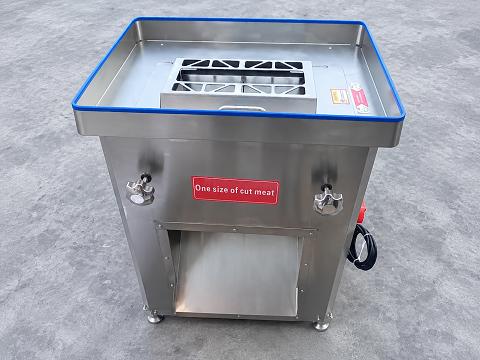
A machine that sits in stock is a machine that ships fast, and this order used that twice. An Uzbekistan customer paid on Monday, October 26, 2026 for a stainless steel meat slicer machine from our meat cutting machine range, the WZ-S08. We built it from stock in three working days, ran meat through it to check the slice, crated it, and moved it south to Guangzhou, where it reached the customer freight forwarder on Monday, November 2.
The handover point is worth noting, because it is where most export orders become somebody else’s problem. Our part ended when the crated machine was signed over in Guangzhou. From there the forwarder takes the booking, the export paperwork and the leg to Tashkent, and the customer keeps control of the shipment without waiting on us for paperwork. This case study is written down because honest timelines are worth more than impressive ones.
what the customer ordered
Uzbekistan customer runs a restaurant, and the machine goes into the back kitchen where the cooks prepare meat for the grill and for plov, the rice dish that is the centre of the table here. This order was one WZ-S08 with two blade groups. 20 mm group went onto the machine, cut for kebab meat and for the lamb and beef that goes into plov. The second group went into the crate next to the machine, so the kitchen can change thickness later without waiting a parcel from China.
The model itself is worth a short note for anyone weighing it against our other cutting equipment. WZ-S08 is a compact single blade group machine. The body, the belt and every part that touches food are food grade 304 stainless steel. It runs on a 2.2 kW motor at 380V, plug uses European standards, puts through 600 kg per hour, and takes up 480 by 600 by 730 mm of floor. It handles fresh pork, beef and lamb, semi-thawed blocks tempered enough to cut cleanly, and bone-in chicken and duck.
That footprint is why it suits a restaurant kitchen. This machine sits on a bench against the wall, next to the prep table, and one cook can load it without a second pair of hands. Our Fleischschneide- und Würfelmaschine carries two belts and a quick change circular blade assembly, which is the better answer when the same line needs strips and cubes and you swap assemblies between runs.
wie die Maschine funktioniert
the blade group
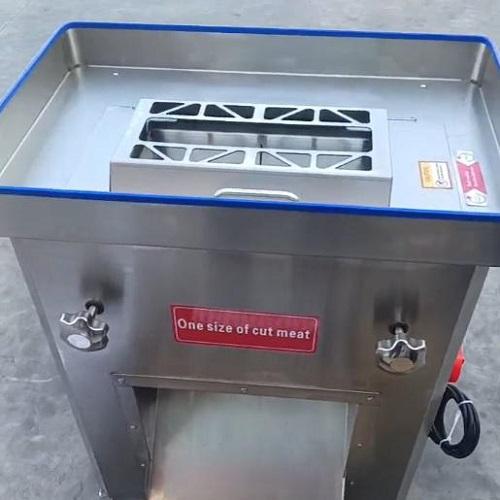
The cut comes from one blade group, two sets of disc blades crossed and interlocked, the two rolls turning inward together. The block dropped into the top port meets the turning blades and is drawn down between them, leaving as uniform strips or slices. Thickness is not a dial, it is the blade spacing, so fitting a group with a different spacing changes the cut.
That single point decides what this machine is. The first pass is slicing. If the recipe calls for cubes, feed the strips back through the top port and the same inward turning blades cross cut them into cubes at a wider spacing or dice at a lower one. Cubing is a second pass, and saying that plainly is more useful than pretending one unit does everything.
the feed port and the discharge chute
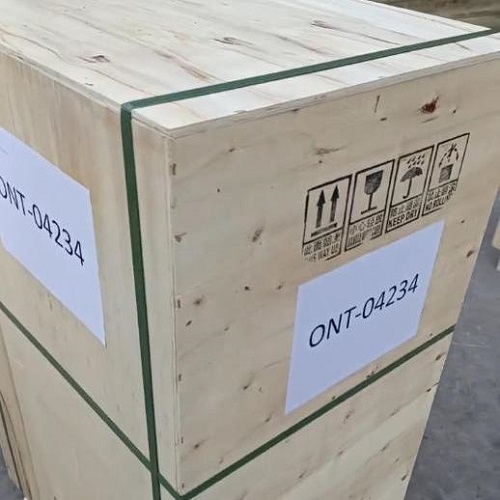
This is a standalone bench machine, not built to bolt into a continuous production line. The operator drops a whole meat block into the top feed port by hand. There is no conveyor feeding it. The block meets the inward turning blade group and the blades cut it into strips. The strips then fall under their own weight and the push of the cutting action into the sloped discharge chute below the blades, and slide out into a container. Because the product leaves by gravity, it does not pile up against the blades, and one cook can keep feeding the machine alone.
control, guard and teardown
A start and stop button, an emergency stop and a guard over the cutting area cover the safety side. The blade group comes out for washing and sharpening, so the whole machine can be rinsed between products in a few minutes rather than needing a crew.
the order timeline from payment to Guangzhou
| Datum (2026) | Milestone | Detail |
| 26. Oktober (Mo) | Zahlung erhalten | Full payment confirmed and the order released to production. |
| 27. Okt. (Di.) | Montage | Stainless steel body and blade group fitted to the frame. |
| 28. Okt. (Mi.) | Wiring and blade setup | Motor wired, emergency stop connected, 20 mm group fitted and spacing checked against the slice the kitchen buys. |
| 29. Okt. (Do.) | Test cut and crating | Meat run through the machine to check slice thickness, then crated with the second blade group and loaded. |
| 30. Oktober bis 1. November | Road to Guangzhou | Crated machine in transit from the factory to the southern port city. |
| 2. November (Montag) | Ankunft und Übergabe | Delivered into the customer’s freight forwarder warehouse in Guangzhou for export. |
Three working days is short enough that every day has one job. Tuesday was mechanical. Wednesday was electrical and setup, and the 20 mm group went on rather than leaving the machine at a factory default nobody asked for. Thursday was the day that mattered for trust, because we ran meat through the blades and checked the slice before anything was crated. A machine that passes a test cut before it leaves is a machine the customer can switch on and run.
The road leg took the rest of the time. Zhengzhou to Guangzhou is a long haul inland, so the machine sat crated for days on end and neither side had to worry about it. It reached the forwarder’s warehouse on November 2, and that was the handover.
what travels in the crate
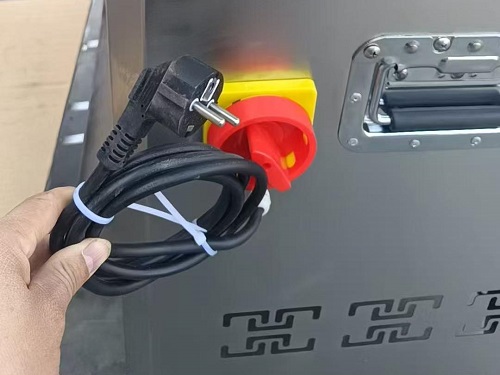
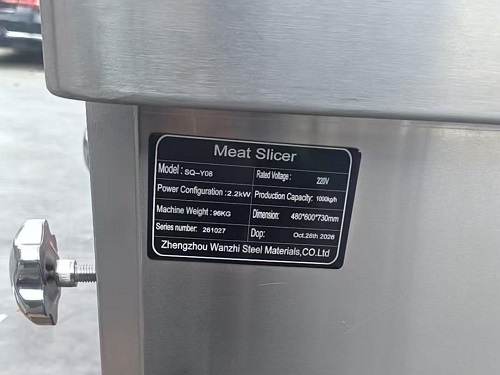
The unit shipped as one assembled machine on its own frame, not as a knocked down kit for the customer to put together. Everything that touches food is 304 stainless steel with a brushed finish that wipes down, and the frame is welded rather than painted, which is what you want in a room that gets hosed every night.
Two blade groups went in the crate, the 20 mm one fitted on the machine and the second one packed separately with its fittings. Spare parts travel with the shipment too, and the ones worth having on this machine are the spare blade set and the fittings. We would rather quote a spare kit up front than have a customer discover a missing blade in a busy week.
The frame and support structure use standard stainless steel tube and bar. If you are working out what a machine like this needs underneath it, the Edelstahlrohr page from our sister steel company covers grade selection and how 304 compares with 316L in a wash down room. The Stange aus 304L-Edelstahl covers the grade used on most frames and supports, and the body sheet is 316 Edelstahlblech when the water in your area is salty or acidic. 316L does add lead time, so it is worth raising at order stage rather than at delivery.
why a stock unit built in three days
The reason this machine moved so fast is that its numbers do not change from order to order. Motor, blade group design, frame size and voltage are fixed for the model, and this customer accepted the standard sheet without asking for a different thickness or a special feed opening. The build became assembly rather than engineering, and engineering is where the days normally go.
The one choice that did need a decision was the blade spacing, and that was settled in one message. A 20 mm group for kebab and plov prep was chosen, the second group was added at the same time, and everything else followed the catalogue. When the specification sheet is already agreed, the factory can start on day one.
I will say plainly that a fast build like this is not possible on every order. Change the blade system, widen the feed opening, or ask for a different voltage, and the job turns into engineering, and engineering takes the days we just saved.
the handover in Guangzhou and who takes over
Most of our export orders to Central Asia leave on the customer’s own freight forwarder, and that arrangement worked here. The machine was crated, moved to Guangzhou, and signed over to the forwarder on November 2. From that point the export booking, the documentation and the sea leg to Tashkent are handled on the buyer side, which is why the customer can track the shipment without chasing us for paperwork.
Guangzhou is a natural place for that handover. The city sits where the inland rivers meet the South China Sea and has been one of the main trading centres in the south for centuries. The port complex now runs its major facilities at Huangpu, Xinsha and Nansha, all built to handle large vessels, so a consignment leaving from there is on a well worn route.
What makes the leg work is Containerisierung. A machine that leaves a factory by truck, passes through a warehouse and then goes onto a ship without being unpacked is cheaper to move than one handled piece by piece, and it arrives with less handling damage. We pack to suit that handover, with the blade group secured separately from the frame so nothing shifts in transit.
If you would rather we take the door to door leg instead, ask for CIF or DDP terms when you request a quote and we will price it. On this order the customer ran the forwarder leg themselves, and that is a reasonable choice for a buyer who already has one working in Guangzhou.
where this machine sits in a restaurant kitchen
In a restaurant the slicer is not a middle stage of a production line, it is the bench the cooks work at. Meat arrives from the market in the morning, gets cut on the machine, and goes to the grill and to the plov pot. Our Lösungen für die Lebensmittelverarbeitung page maps out the stages for a plant, and the contrast is worth knowing before you buy. A factory line is sized for the peak hour of a shift. A kitchen is sized for the hour before service starts, and the machine has to be clean again by the time the second sitting is called.
We have delivered to Uzbekistan before, on a very different machine: an earlier project supplied a customized mixing tank for a client in Uzbekistan. Different product, same country, same approach to specification and handover. More shipments are in our Kundenfallstudien.
how this machine compares to the rest of the cutting range
Choosing between our machines comes down to what the kitchen really needs. If slices are the product and cubes only turn up occasionally, this machine is the right one. In the event cubes are the only output you serve, a vollautomatischer Fleischwürfelschneider does that job without the extra handling. If a kitchen also needs strips and cubes from one machine rather than a second pass, the Fleischschneide- und Würfelmaschine covers more ground. For thin uniform slices of ribs and frozen blocks, our rib and frozen meat slicer is the CNC option, and a meat slicer and shredder machine handles the shredding side.
For a restaurant kitchen the practical differences come down to three things. Floor space, and how long the machine takes to strip down for cleaning between products. Number of hands needed to run it, since this machine is fed by hand from the top port and one cook can work it alone, while a larger machine wants a second person feeding it. And blade changes, because a kitchen that serves kebab one day and plov the next changes its cut more often than a plant does. WZ-S08 wins on the first two and holds its own on the third, which is why it went into the back kitchen here rather than a larger machine that would have taken half the room.
Unsere commercial electric chicken cutting machine und der large rib cutting machine sit at the other end of the range. The first is for small shops portioning birds, the second is for bulk plant work where a rib needs a heavy duty cut. Neither of them makes sense on a restaurant bench.
cleaning, teardown and the standards behind it
Equipment design only gets you so far, because the operator decides how the machine is used day to day. The WHO five keys to safer food manual sets out the principles that apply to any food business: keep clean, separate raw and cooked, cook thoroughly, keep food at safe temperatures, and use safe water and raw materials. Two of those five are about the plant and the person rather than the recipe.
FDA-Leitlinien für sicheren Umgang mit Lebensmitteln makes the same point for anyone serving food, where separating raw meat from other food and washing cutting boards and surfaces after each item is the routine that keeps a kitchen open. FoodSafety.gov food safety guidance sets out the same four steps, clean, separate, cook and chill, and the WHO food safety fact sheet puts the scale in numbers, with an estimated 866 million people falling ill after eating contaminated food each year.
For facilities that want a regulatory reference point, US meat inspection regulations set out sanitation performance standards and HACCP requirements for meat processing in detail. And Britannica’s meat processing overview explains why cutting and portioning sit where they do in the process, from carcass inspection through to chilling and packaging.
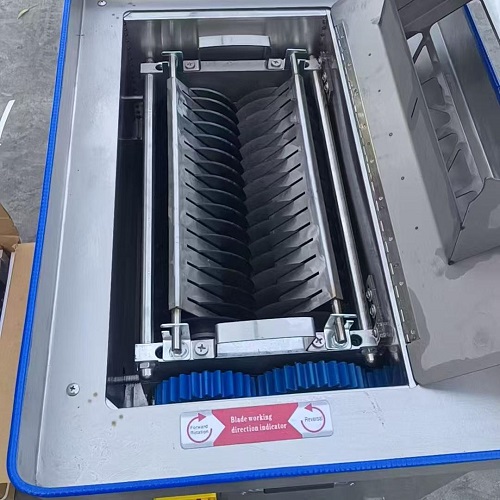
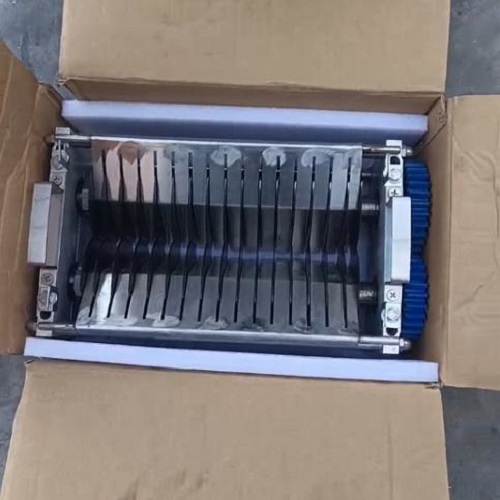
The practical version for this machine is short. Rinse the discharge chute after every run, keep the blade area clean, and do not use metal brushes or abrasive pads on the stainless surfaces, since wire brushing leaves marks that then hold residue. The blade group lifts out, so the cleaning job is minutes of work rather than a call to a technician.
FAQ
Three working days from payment to loading. Payment arrived Monday October 26, 2026, assembly, wiring and blade setup Wednesday, and the test cut Thursday October 29.
600 kg per hour with a 2.2 kW motor running on 380V. The footprint is 480 by 600 by 730 mm, so it fits a restaurant prep bench.
Yes, as a second pass. The first pass slices at the spacing set by the blade group. Feed those slices back in through the top port and the same blades cross cut them into cubes at a wider spacing or dice at a lower one.
The blade group comes out, so the machine can be rinsed between products. Rinse the discharge chute after every run and avoid metal brushes on the stainless surfaces.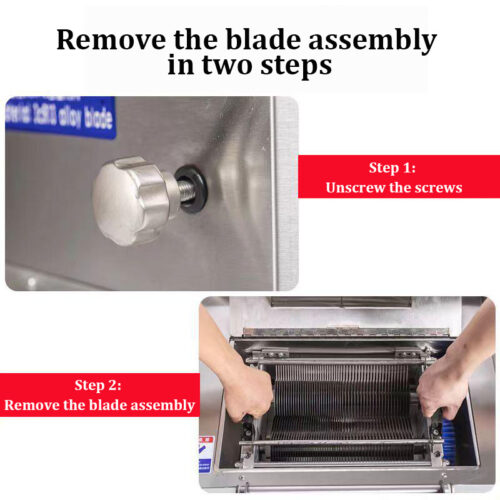
Ähnliche Produkte
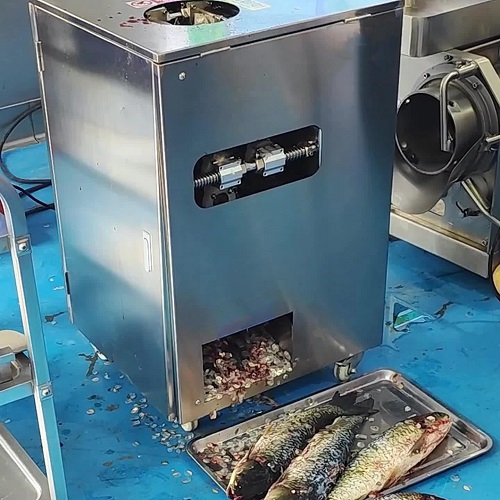
Fischtötungsmaschine mit offener Rückseite
Fischtötungsmaschine mit offener Rückseite Fischtötungsmaschine mit offener Rückseite Einleitung Die vertikale…
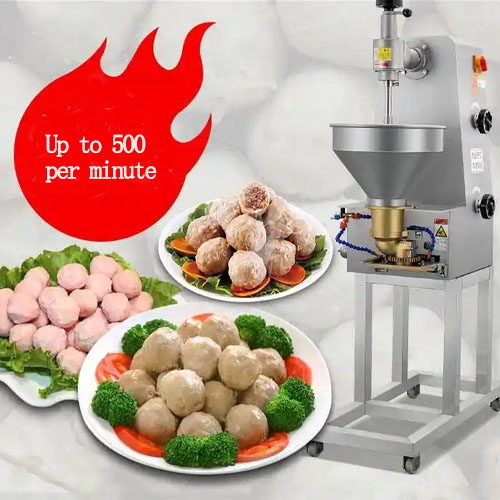
Zweistufige Fleischbällchenformmaschine
Zweistufige Fleischbällchenformmaschine Hochgeschwindigkeits-Fleischbällchenformmaschine Einführung Die WZ-702 Zweistufige Fleischbällchenformmaschine ist…
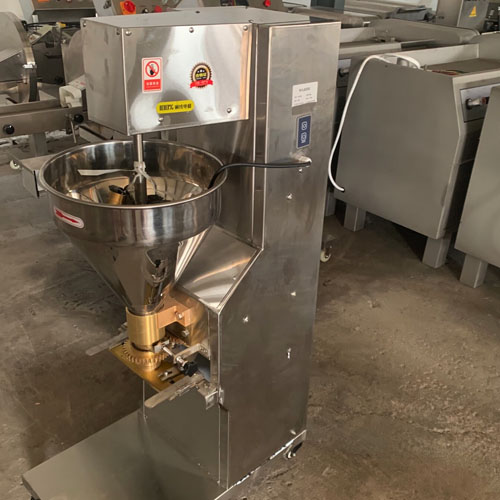
Kommerzielle Fleischbällchenformmaschine
Einführung in die kommerzielle Fleischbällchenformmaschine: Die kompakte, vollautomatische Fleischbällchenformmaschine WZ-605/605S von Wanzhi Machinery…

Fleischschneide- und Zerkleinerungsmaschine
Einführung in die Fleischschneide- und Zerkleinerungsmaschine Diese gewerbliche Fleischschneide- und Zerkleinerungsmaschine ist vielseitig einsetzbar…

Fleischschneide- und Würfelmaschine
Einführung in die Fleischschneide- und Würfelmaschine Dies ist eine professionelle, vollautomatische Fleischschneide- und Würfelmaschine…
Kontakt