
Colloid Mill vs Homogenizer: Which One Do You Need?
Buyers often ask us for a “colloid mill homogenizer” as if the two were one machine. They are not. Both turn a rough mix into a smooth one, but they get there by different forces and they suit different products. Pick the wrong one and you either clog the machine or fail to reach the fineness your product needs. We will walk through how each one works, where it does better, and how to settle on the right one without going back and forth.

What both machines are for
Both take a liquid or semi-liquid that wants to separate and break its droplets or particles down small enough to stay put. Milk fat, oil in a dressing, solids in a sauce, all of these settle or split if the pieces are too big. A colloid mill and a high pressure homogenizer both shrink those pieces. The difference is the tool they use to do it.
How a colloid mill works
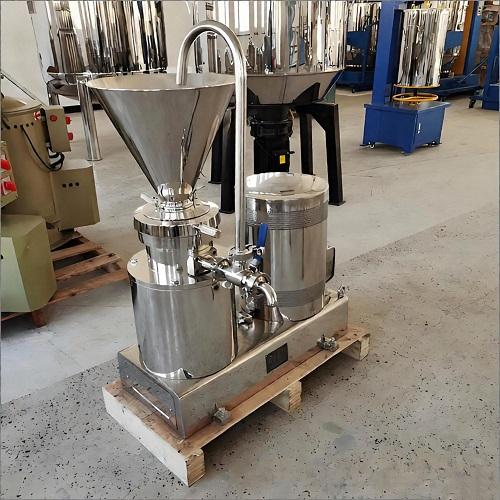
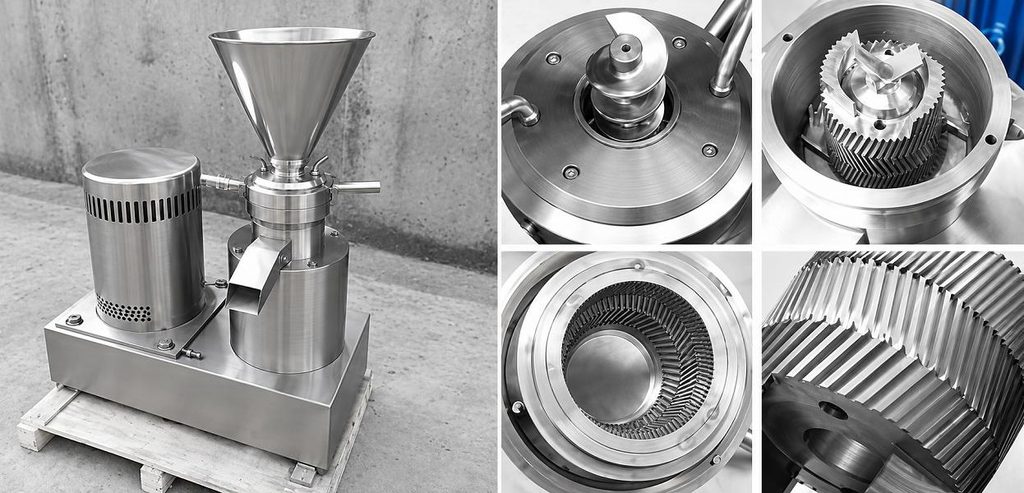
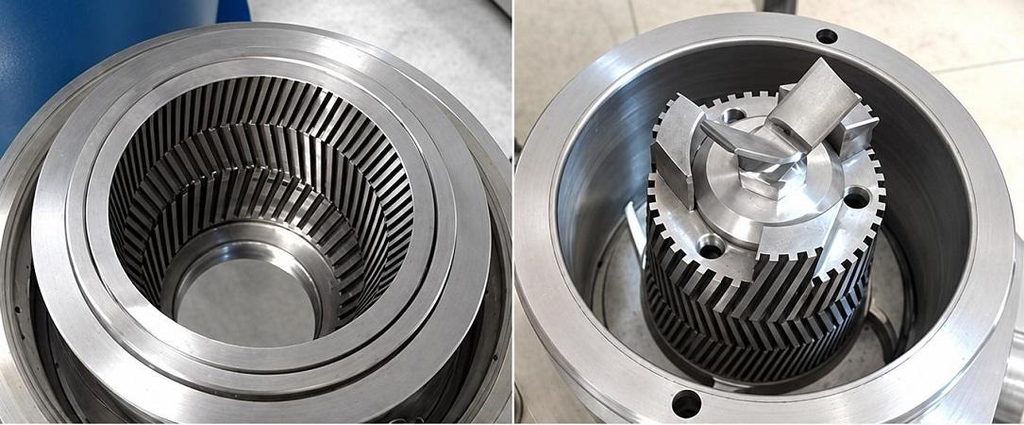
A colloid mill runs a rotor inside a stator at high speed. The gap between them is tight, often from 50 microns down to single digits, and you set it by moving the rotor closer or farther. Product is fed in, pulled through that gap, and the fast shearing action tears droplets and particles apart. Because the work happens in a wide rotor-stator chamber, the mill handles thick pastes and bits that would block a narrow valve.
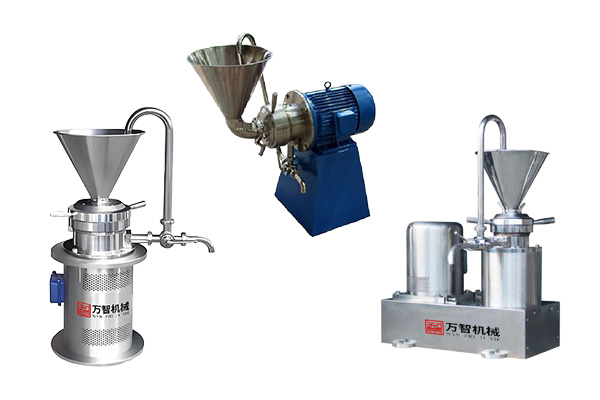
We build the mill in a few layouts. A split colloid mill puts the motor beside the grinding head so the head stays cool and easy to take apart for cleaning. A vertical colloid mill stacks the motor under the head for a smaller footprint. A horizontal colloid mill runs the shaft flat, common on larger lines. For food, the rotors and stators are stainless, and you pick the fineness by gap and speed.
How a high pressure homogenizer works
A high pressure homogenizer takes the opposite route. A pump pushes the product through a valve at high pressure, often 100 to 600 bar. At that valve the liquid hits a sudden pressure drop and a wall of shear, turbulence, and cavitation that shatters fat globules and particles down to roughly 0.2 to 2 microns. No fast-spinning rotor, just pressure forcing fluid through a tiny orifice.
The trade off is clearance. That valve gap is microscopic, so the homogenizer loves thin to medium liquids and hates large particles or thick paste. Push peanut butter through it and you block the seat.
The difference in plain terms
Think of it this way. A colloid mill shears with a spinning gap you can open wide. A homogenizer forces fluid through a fixed micro-valve with pressure. The colloid mill wins on viscosity and particle size; it takes peanut butter, tahini, chili paste, and fibrous mixes without choking. The homogenizer wins on fineness and throughput for pumpable liquids; it gives milk and juice a uniform, stable texture at high volume.
If your product flows through a pipe and needs sub-micron fineness, lean homogenizer. If it is thick, gritty, or loaded with solids, lean colloid mill.
Colloid mill vs homogenizer at a glance
| Factor | Colloid mill | High pressure homogenizer |
|---|---|---|
| Working force | Rotor-stator shear | High-pressure valve |
| Best viscosity | Medium to high, including pastes | Low to medium, pumpable liquids |
| Particle size reached | Down to about 1 micron | 0.2 to 2 microns, finer |
| Throughput | Moderate | High |
| Clogs on | Very thick dry solids | Large particles, thick paste |
| Typical use | Peanut butter, tahini, chili sauce | Milk, juice, dressings |
| Cleaning | Open chamber, straightforward | Valve seat and wear parts |
Which one fits your product
Milk and juice lines almost always want a homogenizer. The fineness and volume are exactly what it does best, and on a dairy line it sits between the mixing tank and the pasteurizer.
Peanut butter, tahini, and chili paste want a colloid mill. These are too thick and too loaded with solids for a valve machine. Our commercial peanut butter machine and tahini machine are built for exactly this, and the chili sauce grinder handles wet spice pastes without clogging. Nut butter lines in general land on a colloid mill. For other nut pastes, the nut butter grinder covers almond, cashew, and similar products.
Sauces and dressings sit in the middle. A thin mayonnaise or a salad dressing often runs through a homogenizer for stability. A thick, chunky sauce does better on a colloid mill. When a line makes both a beverage and a paste, plants often run both machines, one after the other.
Material and build quality
On food and pharma duty the parts that touch product should be stainless, and the grade matters. 304 is the common workhorse; 316L adds molybdenum for better resistance to corrosion and acidic or salty product, which is why many plants choose it for the contact path. We cover the grade choice and the trade offs in our 316 stainless steel sheet notes and our 304 stainless steel coil reference, and we match the steel to what flows through the machine rather than defaulting to one grade.
Frames and non-contact structure can be 304. The finer the product and the harsher the cleaner, the more 316L earns its place.
Mistakes to avoid when choosing
The first mistake is buying by demo. A homogenizer looks impressive on water and a colloid mill looks great on a soft paste, but your real product is what counts. Send a sample and run a trial.
The second is ignoring viscosity. People spec a homogenizer for a paste and wonder why the seat blocks, or spec a colloid mill for a beverage and cannot hit the fineness. Match the machine to the thickest, grittiest thing you will run.
The third is treating them as interchangeable. They are not, and the comparison above shows why. Use each where it is strong.
Running both on one line
Many plants run both. A typical flow is: blend in a jacketed mixing tank, fine the emulsion in a homogenizer for beverages, or send the paste to a colloid mill, then heat treat in a fresh milk pasteurizer, then fill with a dual-head paste filling machine. Wiring the machines as one line, with matching pressures, fittings, and CIP paths, is what keeps the finished product consistent and the cleaning simple.
Still deciding between a colloid mill and a homogenizer?

Tell us your product, its viscosity, and your daily volume. We build both, and we would rather spec the right one than sell you the bigger one. Talk to our engineering team and we will match the machine to your line.
FAQ
A colloid mill shears product in a spinning rotor-stator gap you can open wide, so it handles thick pastes and solids. A homogenizer forces liquid through a micro-valve at high pressure, so it gives thinner liquids a finer, more uniform result at higher throughput. They share a goal but use different forces.
A colloid mill. Peanut butter is too thick and too loaded with solids for a homogenizer valve, which would block. A colloid mill takes the paste through its rotor-stator gap and reaches the smooth texture peanut butter needs.
Not on most lines. A homogenizer excels on pumpable liquids at sub-micron fineness, but it cannot take the thick pastes and particles a colloid mill handles. Plants that make both beverages and pastes often run both machines.
A colloid mill handles medium to high viscosity, including pastes and fibrous mixes. A homogenizer is built for low to medium viscosity pumpable liquids. If the product flows through a pipe it suits a homogenizer; if it is thick or gritty it suits a colloid mill.
A high pressure homogenizer. Milk and juice need fine, stable textures at volume, which is exactly what a homogenizer delivers. It typically sits between a mixing tank and a pasteurizer on the line.
Inquiry Form
Latest Articles
UHT Sterilization vs Pasteurization Difference
Colloid Mill vs Homogenizer: Which One Do You Need?
Fruit and Vegetable blancher
Double channel pulping machine
Single Channel Pulping Machine
Latest Products


Product Categories
Stainless Steel Tank
- Stainless Steel Wine Tanks
- Stainless Steel Water Storage Tank
- Stainless Steel Fermentation Tanks
- Stainless Steel Jacketed Kettle
- Pasteurizing Machine
Meat Processing Machine
Fruit and VegetableProcessing Machinery
Oil Press Machines
Colloid Mill
Extraction Machine
Packaging Machinery
Contact Us
- Mobile/Wechat: +8618595716541
- Whatsapp: +8618736065220
- Email: info04@wanzhisteel.com
- Address: 10F, Building B, Erqi Center, Erqi District, Zhengzhou City, Henan Province, China