
High Shear Emulsifier: Specs, Applications and Buying Guide
Introduction
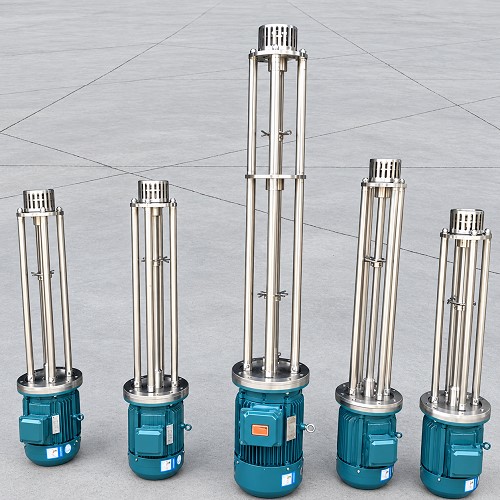
High shear emulsifier is a batch processing machine that blends, disperses and emulsifies materials too thick or too hard to mix with a simple stirrer. It runs a fast spinning rotor against a fixed stator. The narrow gap between the two pulls material in, shears it, and pushes it back out at high speed. That is what lets a plant turn separated phases into one stable product without running the batch for hours.
This guide covers what the machine is, what it does on a line, how the rotor and stator head works, the spec range from model L80 to L290, and how to pick the right one for your product.
What a high shear emulsifier is used for
The unit handles five job types, and most food, cosmetic and chemical plants use more than one:
- Mixing: syrup, shampoo, detergent, juice concentrate, yogurt, dessert, blended dairy, ink, ceramic glaze
- Dispersing: methyl cellulose, colloid and carbide dissolution, oil water pre emulsification, seasoning bases, stabilizers, alumina, pesticide
- Dispersing fine solids: suspensions, pill coating, drug depolymerization, paint, lipstick, vegetable soup, mustard, catalyst, pigment, modified asphalt, nano material prep
- Emulsifying: ointment, cold cream, face mask, cream, flavoring emulsion, asphalt and resin emulsion, wax emulsion, water based polyurethane, pesticide
- Homogenizing: ointment, cream, tissue slurry, dairy, juice, printing ink, jam
If your product separates in the package or throws sediment after a day, a high shear emulsifier is usually the first machine to reach for.
Why choose high shear emulsifier
- Faster batches: strong shear shortens the time to a stable mix compared with a paddle agitator.
- Fewer dead spots: the claw type, two way suction pulls the whole batch, not just the center.
- Handles thick and lumpy feed: it takes paste and suspension that a homogenizer valve would clog on.
- One machine, many jobs: mix, disperse, emulsify and homogenize with the same head by changing speed and gap.
- Easy to add to a line: drop a lift unit into a tank you already own, or take a full emulsifying tank.
Core components of a high shear emulsifier
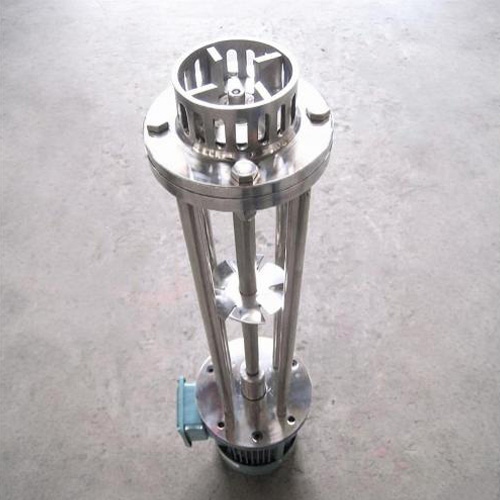
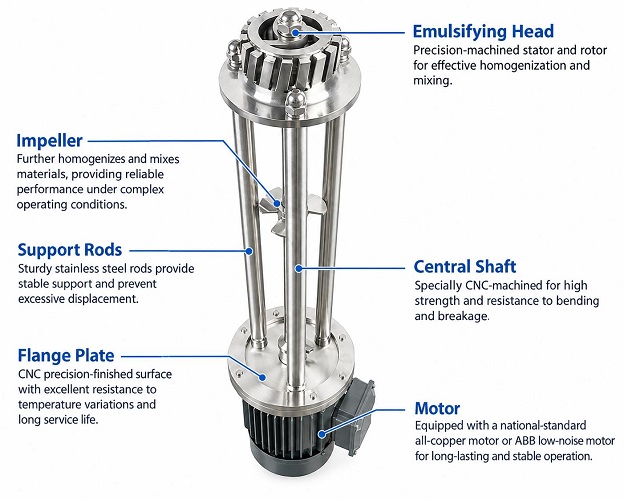
A standard unit has these parts:
- Rotor and stator head: the working core. The rotor spins inside the stator; the gap sets the fineness. We offer multiple tooth shapes for coarse, medium and fine shear.
- Drive motor and shaft: a high speed motor (see spec table) on a rigid shaft with a mechanical seal.
- Lifting or fixed stand: small units lift on a column so you move them between tanks; large units bolt to the tank top.
- Tank or mounting flange: either your own vessel or a purpose built emulsifying tank.
- Control box: speed control, timer, and emergency stop. Inverter control lets you tune shear to the batch.
- Inlets and outlets: top and bottom feed ports plus a discharge valve on tank mounted versions.
The head and any wetted part that touches product are 304 or 316L stainless steel. For coastal, salty or acidic lines we move to 316L stainless steel sheet from our sister mill; for most food and dairy work 304 stainless steel coil is enough.
How a high shear emulsifier works
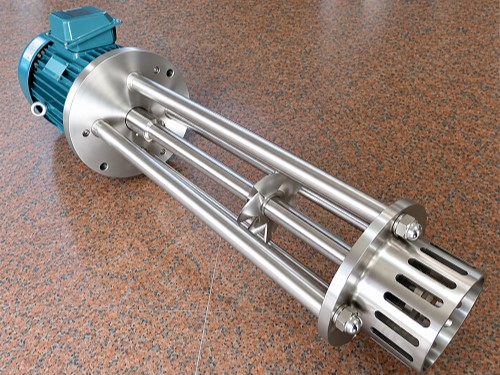
High shear dispersion means taking one or more phases and spreading them evenly into a continuous phase, even when the phases do not naturally mix. The rotor spins fast enough to create a high tangential speed and strong kinetic energy. Material in the narrow gap gets cut, squeezed, rubbed and torn at the same time. With the right process and a small amount of additive, immiscible solid, liquid and gas phases come together into a stable product.
The batch cycle runs like this:
- The spinning rotor pulls material in from the top and bottom feed zones at once, straight into the working chamber.
- Centrifugal force drives it into the tight stator rotor gap, where it is squeezed and impacted and partly emulsified.
- At the rotor edge the line speed reaches at least 15 m/s and can hit 40 m/s. That is the real shearing zone: material is dispersed, emulsified, homogenized and broken, then pushed out through the stator slots.
- The stream hits the tank wall, changes direction, and the upper and lower suction of the rotor pulls it back. After several loops the batch is uniform.
For very thick or sticky material, pair the batch unit with an inline high shear homogenizer so the loop keeps moving instead of stalling at the top.
High shear emulsifier vs other mixing machines
Buyers often weigh this unit against two neighbours:
- High shear emulsifier vs high pressure homogenizer: the homogenizer pushes thin liquid through a valve at high pressure for very fine, uniform droplets, but it clogs on particles and thick paste. The high shear emulsifier takes higher viscosity and some solids. Plants with both run the emulsifier first, then the homogenizer.
- High shear emulsifier vs colloid mill: a vertical colloid mill grinds continuously through a tighter gap and suits peanut butter, chili paste and tahini. The high shear emulsifier works inside a batch tank and suits emulsions and dispersions you want to keep in the vessel.
Pick by feed and goal: thin and needs finest texture, go homogenizer; thick paste with solids, go colloid mill; batch emulsion or dispersion in a tank, go high shear emulsifier.
Technical specifications
We build the range in two speed bands. Small models run at 2800 to 2900 rpm; large models run at 1400 to 1500 rpm to stay stable at higher power.
| Model | Power (kW) | Speed (rpm) | Batch volume (L) |
|---|---|---|---|
| L80 | 1.1 | 2800 to 2900 | 5 to 40 |
| L90 | 1.5 | 2800 to 2900 | 20 to 70 |
| L100 | 2.2 | 2800 to 2900 | 50 to 100 |
| L120 | 4 | 2800 to 2900 | 100 to 300 |
| L140 | 7.5 | 2800 to 2900 | 200 to 800 |
| L160 | 11 | 2800 to 2900 | 300 to 1000 |
| L180 | 18.5 | 2800 to 2900 | 500 to 1500 |
| Model | Power (kW) | Speed (rpm) | Batch volume (L) |
|---|---|---|---|
| L200 | 22 | 1400 to 1500 | 800 to 2000 |
| L220 | 30 | 1400 to 1500 | 1000 to 3000 |
| L240 | 37 | 1400 to 1500 | 1500 to 5000 |
| L270 | 55 | 1400 to 1500 | 2000 to 8000 |
| L290 | 75 | 1400 to 1500 | 3000 to 10000 |
All ratings are for water like, low viscosity feed at room temperature. Thick or sticky material needs a larger model or an inline unit in the loop.
Two notes from the workshop: if the medium is very viscous, run the batch emulsifier with an inline high shear unit; and for high temperature, pressure, flammable, explosive or corrosive duty, send us the exact condition so we size and build to match. The data in this table is for reference only; the correct parameters are subject to the actual product provided.
How to choose a high shear emulsifier
- Match volume to batch size: pick the model whose batch range covers your fill, not your peak. A 500 L batch sits well in an L160 or L180, not an L80.
- Check viscosity first: thin liquids stay in the 2800 to 2900 rpm band; thick paste drops to the 1400 to 1500 rpm band with more power.
- Decide fixed or lift: one tank and many formulas, take a lift unit; one product all day, bolt a fixed head to the tank.
- Pick the steel: 304 for most food and dairy; 316L for salt, acid, coastal or pharma lines.
- Plan the loop: if the batch stalls, add the inline high shear unit and a jacketed mixing tank so you heat or cool while you shear.
- Leave room for cleaning: a CIP cleaning tank in the same line keeps the head and tank sanitary between runs.
Accessories you can add
- Inverter speed control: tune shear to each formula instead of running flat out.
- Lift column and trolley: move one head across several tanks.
- Jacketed emulsifying tank: heat or cool the batch while shearing.
- Vacuum hood: pull air out so the emulsion stays bubble free, useful for cream and ointment.
- CIP spray ball: clean the head and tank without teardown.
- Explosion proof motor: for solvent or flammable duty.
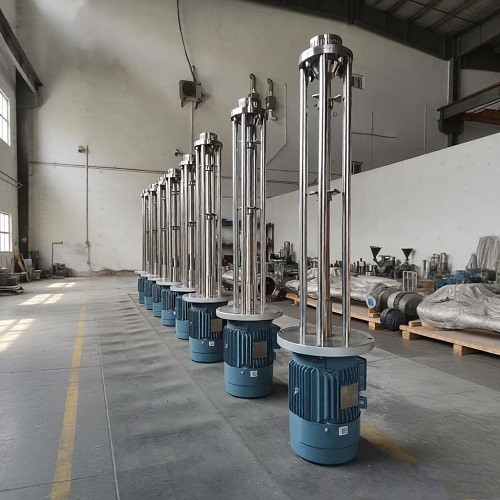
Putting the line together
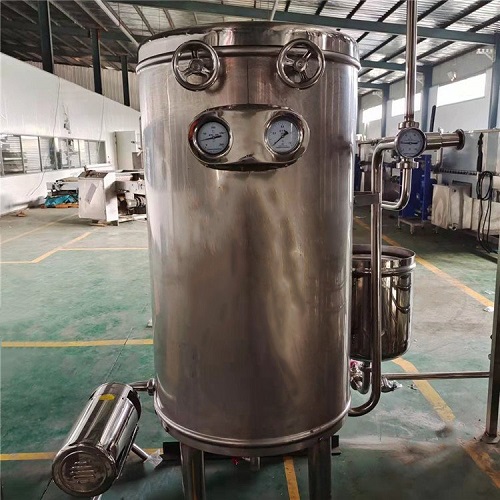
A typical emulsifying line pairs the high shear emulsifier with a jacketed mixing tank for heat control, then a high pressure homogenizer for final fineness, then an UHT sterilization tank if the product is shelf stable, and a CIP cleaning tank between runs. We build these as separate machines or as one frame, and we size each step to the same batch so nothing waits on the next.
Why choose Wanzhi
We are a manufacturer, not a trader, so the emulsifier, tank, jacket and control are built and tested in house before they ship. That means one drawing, one contact, and one warranty across the line. We customize the head gap, motor power, steel grade, lift or fixed mount, and jacket to your product, and we keep the 304 and 316L stock at our sister mill so lead time stays short. If you already run a tank, send the drawing and we will size a drop in head that fits it.
FAQ
Not always. If you only mix at room temperature, a drop in head is enough. If you heat, cool or hold the batch while shearing, a jacketed emulsifying tank saves a transfer step.
The emulsifier shears a batch inside a tank through a rotor and stator head and takes thick or slightly solid feed. A high pressure homogenizer forces thin liquid through a valve for finer droplets but clogs on particles. Plants often run both, emulsifier first.
The L series covers 5 to 40 L on the small L80 up to 3000 to 10000 L on the L290. Pick the model whose range covers your working fill, not your rare peak.
Yes, but thick feed needs the lower speed, higher power band (L200 to L290 at 1400 to 1500 rpm) or an inline unit in the loop. Very sticky material should not rely on a batch head alone.
Use 304 stainless steel for most food, dairy and cosmetic work. Move to 316L when the line is salty, acidic, coastal or pharmaceutical, since the added molybdenum resists chloride corrosion.
Yes. Our lift type emulsifier drops into an existing vessel on a column and trolley. Send the tank drawing and we size the head, shaft length and mount to fit.
Associated equipment
- High pressure homogenizer
- Colloid mill
- Jacketed stainless steel mixing tank
- UHT sterilization tank
- CIP cleaning tank
Browse the full homogeneous emulsification range or contact us for a sized quote.
Related Products
SS water storage tank
SS water storage tank: Types, Specs and How to Choose SS water storage tank Introduction…

CIP cleaning tank
Stainless Steel CIP cleaning tank CIP on-site cleaning tank Introduction A CIP cleaning tank, short…

Stainless steel sterilization tank
Stainless steel sterilization tank Stainless steel sterilization tank Introduction If your line handles anything a…
UHT sterilization tank
UHT sterilization tank UHT sterilization tank Introduction Every liquid food line eventually hits the same…
Vacuum degassing tank
vacuum degassing tank vacuum degassing tank Introduction If you run a juice, dairy, or soy-milk…
Contact Us