
Colloid mill for peanut butter, tomato sauce and chili paste
Peanut butter, tomato sauce and chili paste show up together on almost every colloid mill inquiry we get. They look different in the jar, but they put the same demand on the machine: turn a chunky, separated, seeded feed into a smooth paste that stays mixed on the shelf. A colloid mill does that with a fast spinning rotor and a fixed stator. The gap between them is where the work happens. Set it wrong and you burn the oil out of peanut butter, leave tomato skin in the sauce, or scorch the capsaicin out of chili paste.
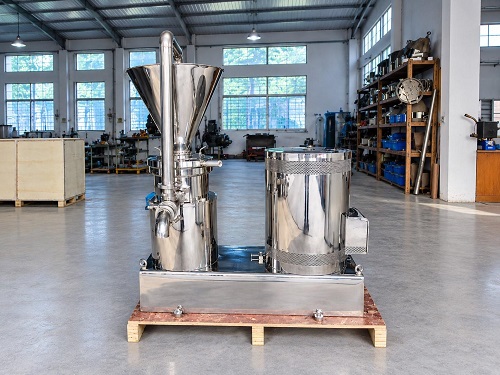
What a colloid mill does
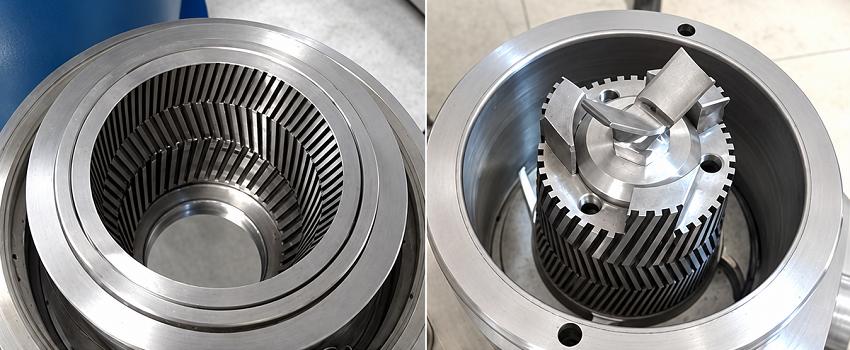
The colloid mill is a wet grinder. Material drops into a conical chamber where a rotor turns at thousands of rpm against a stationary stator. The tiny gap, usually between 50 and 300 microns, shears, tears and emulsifies the feed as it passes through. There is no screen to clog, and you change the fineness by moving the gap, not by swapping parts. That is why the same machine handles a thin tomato passata and a thick peanut butter: you open or close the gap and change the feed rate.
For a food line this matters because the three products below are viscous, full of particles, and quick to separate or burn. A blade grinder or a stone mill leaves grainy texture and hotspots. A vertical colloid mill keeps the product moving through the shear zone in one pass, so it gets fine without sitting over heat.
Why these three products need a colloid mill
- Peanut butter is mostly oil held in a solid matrix. Grind it too coarse and it separates; grind it too fine or too hot and the oil weeps out and the flavor turns bitter.
- Tomato sauce carries skin, seed and fibrous pulp. You want it smooth without cooking the fresh acidity out, and without a mill that lets the seeds through whole.
- Chili paste is oily, abrasive from the seeds, and heat sensitive. Overwork it and you lose the bright capsaicin punch and pick up a cooked taste.
Colloid mill for peanut butter
This is where the commercial peanut butter machine earns its name. Roasted peanuts go in and a stable, spreadable butter comes out. The usual mistake is one pass at the tightest gap. Peanut butter grinds better in two stages: a coarse pass to break the kernels, then a fine pass to emulsify the oil into the solids. Our nut butter grinder is built for exactly this, with a wider rotor so the paste does not stall the gap.
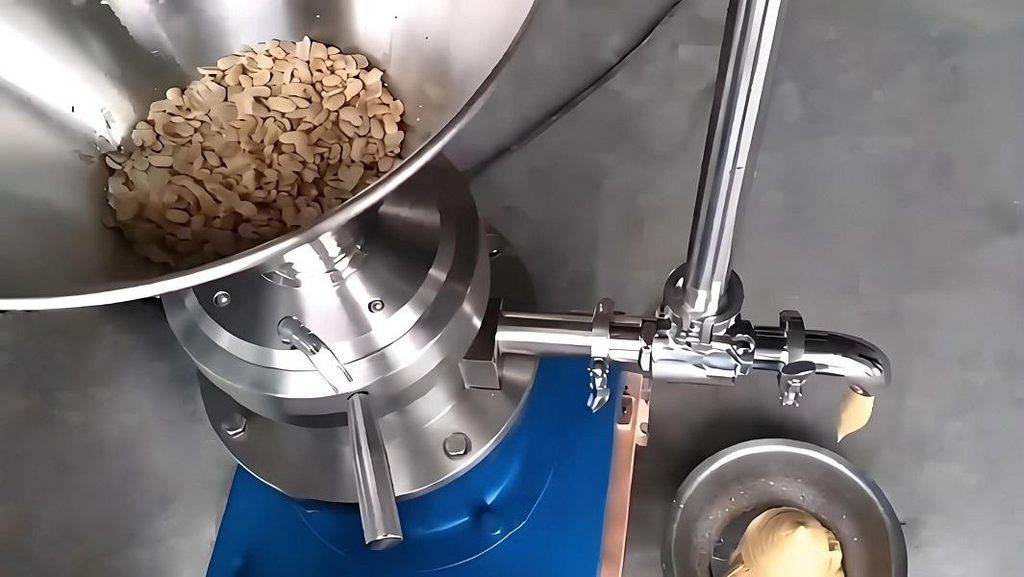
Keep the gap around 80 to 150 microns on the fine pass, feed steadily, and let the machine cool between batches if you run continuous. The oil stays bound, the texture stays spreadable, and you avoid the float-on-top problem that cheap single pass grinders leave behind.
Colloid mill for tomato sauce
Tomato sauce wants smoothness without heat damage. The mill takes cooked or raw tomato crush and pulls out the skin and seed, leaving a uniform passata style sauce. Because the shear is mechanical and fast, you do not need to boil the sauce down to break it up, so the fresh tomato note stays.
Run the gap a touch tighter than peanut butter, around 50 to 120 microns, since tomato has less oil to lubricate the gap and more fibrous pulp to clear. Acidic feed like tomato is also why we build the contact parts from 304 stainless steel as standard, moving to 316L on lines that run salty or cleaning heavy cycles.
Colloid mill for chili paste
Chili paste is the hardest of the three on the machine. The seeds are abrasive, the oil carries the heat and the flavor, and the whole thing stains. A chili sauce grinder set up for paste keeps the gap moderate, around 100 to 200 microns, so it emulsifies the oil and flesh without pulverizing seeds into grit. Too tight and you grind the seeds fine enough to turn the paste bitter and sandy.
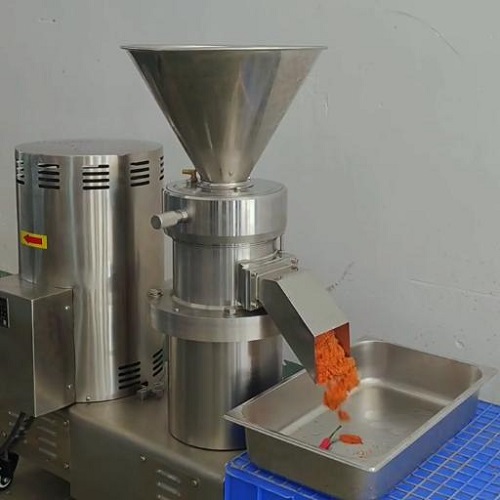
Chili also benefits from cooling. The friction of the rotor adds heat fast, and capsaicin and bright color fade with it. A water cooled stator jacket or a slower feed keeps the paste red and sharp instead of cooked and dull.
How to choose the right colloid mill for these
The model matters less than the setup, but a few choices make life easier.
| Product | Typical gap (microns) | Notes |
|---|---|---|
| Peanut butter | 80 to 150 (fine pass) | Two stage grind, watch oil temperature |
| Tomato sauce | 50 to 120 | Tighter gap, 304 or 316L for acid |
| Chili paste | 100 to 200 | Cooling helps, avoid over grinding seeds |
Beyond the gap, pick capacity to your hourly need, pick 316L over 304 if the line runs brine, citrus or aggressive CIP, and pick a cooled stator if you grind chili or run long shifts. The rotor and stator are the wear parts, so a machine with a cheap, replaceable stator ring costs less to keep running than a sealed one.
Colloid mill or homogenizer for these products
People often ask whether a high pressure homogenizer would do the job instead. For these three, the colloid mill usually wins. A homogenizer forces product through a narrow valve at high pressure; it is brilliant for thin liquids like milk and juice where you want sub micron droplets. But peanut butter and chili paste are too thick and too particle loaded for a valve, and a homogenizer strains at paste. The colloid mill handles high viscosity and visible particles without clogging, which is exactly the peanut butter and chili case. Use a homogenizer after the mill only if you need an extra fine, fully emulsified sauce.
Putting the line together
A colloid mill rarely runs alone. The usual food line runs a jacketed mixing tank to heat and blend the batch, the colloid mill to grind it smooth, a pasteuriser if the product is shelf stable, and a paste filling machine to pack it. Peanut butter skips pasteurisation but still benefits from a jacketed tank to keep the mass warm and pumpable before grinding.
FAQ
A blade or stone grinder can crush peanuts, but it leaves a coarse, separating butter and builds heat that turns the oil bitter. A colloid mill emulsifies the oil into the solids in one pass, which is what keeps the butter smooth and stable on the shelf.
Around 50 to 120 microns. Tomato has little oil to lubricate the gap and more fibre to clear, so a tighter gap than peanut butter gives the smooth passata texture without whole seeds slipping through.
No. The mill shears the seeds and skin fine enough that most sauces come out smooth. If you want a completely seed free product, a de seeder before the mill helps, but it is optional for a rustic sauce.
The rotor friction adds heat fast. Chili loses its bright color and sharp capsaicin punch as it cooks, so a water cooled stator or a slower feed keeps the paste red and fresh tasting.
Use 304 for standard peanut butter and tomato lines. Use 316L where the line runs salty brines, citrus or aggressive daily CIP, since 316L resists pitting that 304 eventually shows.
Yes. Change the gap and clean between runs. Peanut butter leaves the most oil, so flush with a warm neutral oil or sanitizer before switching to tomato or chili to avoid cross flavor.
Get a colloid mill set up for your product
Tell us what you grind, your hourly volume and your target texture. We size the rotor, gap range and cooling, and match it to a mixer, pasteuriser and filler so the line runs end to end. Browse the colloid mill range or talk to our team about a peanut butter, tomato or chili line.
Related: commercial peanut butter machine · chili sauce grinder · high pressure homogenizer · 316L stainless steel sheet
Inquiry Form
Latest Articles
Vacuum packaging machine buying guide
High Shear Emulsifier
Colloid mill for peanut butter, tomato sauce and chili paste
How to choose a stainless steel wine fermentation tank
Vertical round bottle adhesive labeling machine
Latest Products

Product Categories
Stainless Steel Tank
- Stainless Steel Wine Tanks
- Stainless Steel Water Storage Tank
- Stainless Steel Fermentation Tanks
- Stainless Steel Jacketed Kettle
- Pasteurizing Machine
Meat Processing Machine
Fruit and VegetableProcessing Machinery
Oil Press Machines
Colloid Mill
Extraction Machine
Packaging Machinery
Contact Us
- Mobile/Wechat: +8618595716541
- Whatsapp: +8618736065220
- Email: info04@wanzhisteel.com
- Address: 10F, Building B, Erqi Center, Erqi District, Zhengzhou City, Henan Province, China