
How to choose a stainless steel wine fermentation tank
Buying a wine fermentation tank looks simple until you start ticking boxes. Capacity, shape, grade of steel, cooling, and the small fittings that sit on the side all change how the wine behaves and how long the tank lasts. A stainless steel wine fermentation tank is a long term buy, so the wrong pick costs you in spoiled batches and replacements, not just the first invoice. This guide walks through the choices that matter, in the order you should make them.
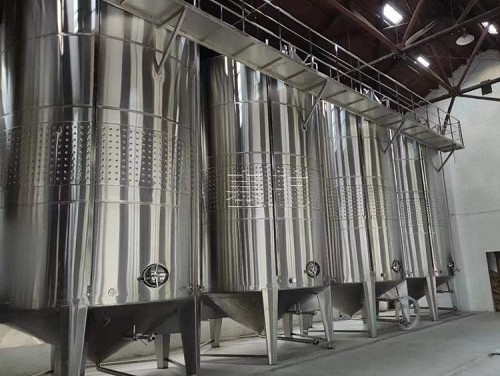
Why stainless steel instead of oak or plastic
Oak adds character but it is porous, it needs constant upkeep, and it gives every batch a flavor you cannot turn off. Plastic is cheap and light but it scratches, it holds odors, and it does not handle heat or pressure. Stainless steel does none of those things. It is inert, so the wine tastes like the wine, not the vessel. It polishes smooth inside, so there are no crevices for bacteria to hide. It takes cooling jackets and pressure ratings that wood and plastic cannot. For a commercial cellar that has to pass hygiene audits and turn out consistent wine, steel is the default for good reason.
Start with tank shape, because it changes everything
The shape decides how yeast settles, how you rack the clear wine off the lees, and how easy the tank is to clean. The three shapes you will meet are cylindrical with a flat or dished bottom, cylindrical with a conical bottom, and the floating roof type used more for storage than active fermentation.
A conical wine fermentation tank is the one most small and mid size wineries reach for. The cone at the bottom collects yeast and sediment in one point, so you can drop the lees through a racking port without stirring the whole batch. That single feature cuts racking time and protects the wine from oxidation. A flat bottom tank is cheaper and fine for short ferments where you pump over, but you will spend more labor pulling sediment out later.
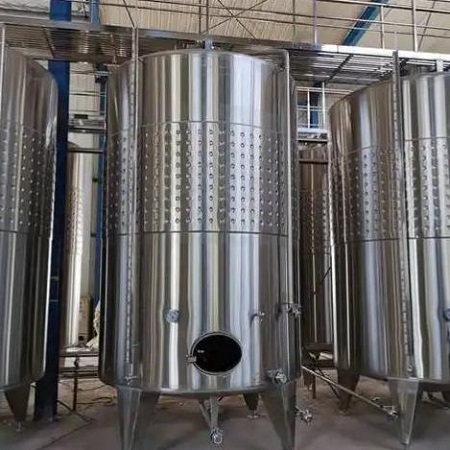
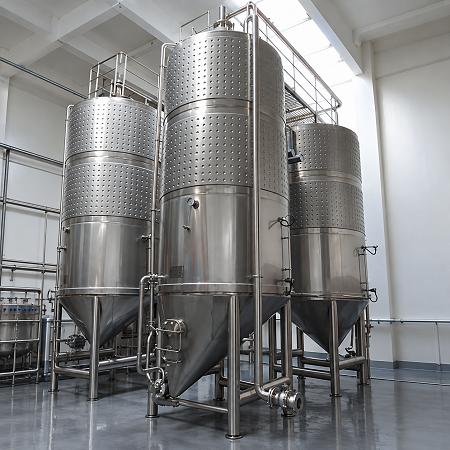
The floating roof tank is a different tool. It uses a moving lid that sits on the wine surface to cut oxygen pickup during storage, so it belongs after fermentation, not during it. Keep that distinction clear: a fermentation tank and a storage tank solve different problems, and mixing them up is a common first time buyer mistake.
Size the tank to your fruit, not your ambition
Capacity is where people overspend or bottleneck themselves. Work from crush volume, not from how much you hope to make. A rough rule: one ton of grapes gives around 700 to 750 liters of must, so a 1000 liter tank ferments roughly 1.3 to 1.4 tons of fruit. Plan for filling tanks to about 80 percent so foam and cap have room, and add one or two spare tanks for blending and topping.
If you run multiple small batches of different varietals, several tanks of 500 to 1000 liters beat one giant tank, because you can ferment each lot separately. If you crush by the truckload, 2000 to 5000 liter tanks keep labor sane. Match the count to your number of distinct lots, and remember tanks you cannot fill sit idle and take up floor space.
304 or 316L: the steel grade question
Most wine tanks are built from 304 stainless steel, and for a standard winery running grapes and a normal clean in place cycle, 304 is the right call. It resists the mild acids in wine and the alkaline and acid washes used to clean. The case for 316L comes up when the environment gets tougher than grapes: coastal cellars with salty air, lines cleaned with stronger chemistry, or tanks that also handle citrus or brine products. The molybdenum in 316L shrugs off pitting that 304 eventually shows in those conditions.
| Factor | 304 stainless steel | 316L stainless steel |
|---|---|---|
| Wine acidity | Handles it well | Handles it well |
| Cost | Lower | Higher |
| Coastal or salty air | Can pit over time | Holds up |
| Strong cleaning chemistry | Adequate | Better |
| When to pick | Standard wineries | Seaside, aggressive CIP, mixed product lines |
The grade is only half the story. The interior polish and weld finish matter as much, because a rough weld traps residue and becomes a sour spot. Ask for a mirror or near mirror internal finish and full penetration welds, whichever grade you choose. For the raw steel itself, our sister mill documents both 304 coil and 316L plate in depth if you want the metallurgy before you specify.
Cooling decides whether you control fermentation
Fermentation throws off heat, and red wine in particular can climb past the temperature where you want it. Too warm and the yeast stalls or makes off flavors; too cool and it drags. A jacketed mixing tank style jacket on the tank wall lets you run glycol or chilled water through it to hold the must in the 18 to 28 degree band most ferments want.
If you only make small batches in a cool cellar, a plain tank and ambient temperature may be enough. Once you scale up or your summers run hot, a jacket stops being a luxury and becomes the thing that lets you repeat a good vintage. A temperature gauge and a sample port near the bottom are the fittings that make a jacket useful, so spec them together.
The fittings are where quality hides
A tank is more than a cylinder. The top manway large enough to climb into makes cleaning and inspection bearable. A racking port near the cone bottom lets you pull clear wine without dragging lees. A sample valve at working height means you taste without opening the tank. A pressure relief or blanketing option protects against the CO2 a ferment builds. A CIP spray ball on the roof means you can clean without a person inside.
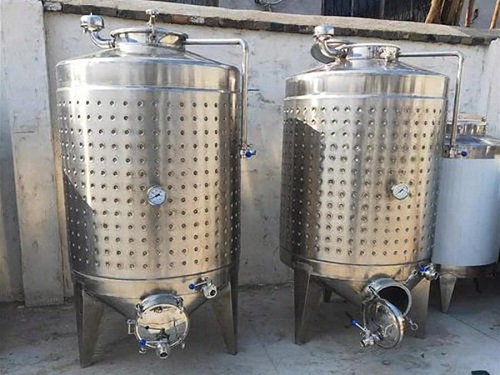
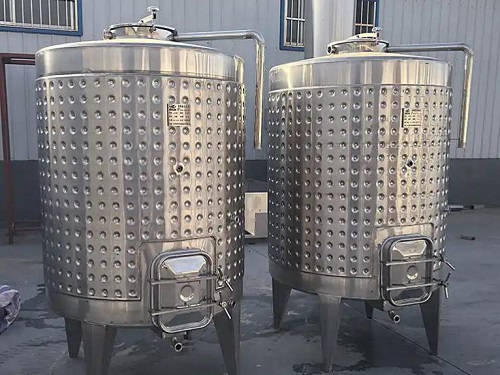
Skip the cheap fittings and you will feel it every week. Buy the tank with the ports placed where your hoses and pump sit, not where the drawing looks tidy.
Cleaning is part of the tank choice
The residue has a significant impact on the fermentation of wine. A tank that cleans slowly becomes a tank that gets cleaned badly, and a badly cleaned tank ruins the next lot. That is why a CIP cleaning tank paired with your fermenters pays for itself. The spray ball, smooth interior, and a CIP loop that reaches turbulent flow keep the inside spotless without a person on a ladder with a brush.
Common mistakes when buying
The first mistake is buying one oversized tank instead of several right sized ones, which strands you when you have three varietals and one full barrel.
Second is forgetting cooling until the hot year, when the wine tastes like it. The third is treating the steel grade as the only material decision and ignoring the internal polish, which is what touches the wine.
Last is buying tanks and a CIP set from different suppliers on different standards, so the cleaning loop never quite fits.
Frequently asked questions
Size from your crush, not your target output. One ton of grapes yields about 700 to 750 liters of must, so a 1000 liter tank handles roughly 1.3 tons. Fill to about 80 percent and keep one or two spare tanks for blending and topping.
Use 304 for a standard winery. Move to 316L when the cellar sits near the coast, runs aggressive cleaning chemistry, or shares the tank with salty or acidic non wine products, because the extra molybdenum resists pitting.
Only if you ferment at scale or in a warm climate. Small batches in a cool cellar can run ambient, but a jacket is what lets you hold the must in the right temperature band and repeat a good vintage year after year.
The cone collects yeast and lees at one point, so you rack clear wine off the bottom without disturbing the batch. It cuts labor and limits oxygen pickup compared with a flat bottom tank.
With 304 or 316L, a mirror finish inside, and a proper CIP routine, a tank runs for decades. The things that shorten life are poor welds, skipped cleaning, and using the wrong grade in a corrosive environment.
Yes, as long as you clean and rinse thoroughly between lots and size it for your largest batch.
Get a tank set matched to your cellar
Tell us your annual crush, the number of distinct lots, and whether your cellar runs warm or near the coast. We size the shape, capacity, steel grade, cooling, and fittings as one system, and we build the fermentation tanks, cold stabilizer, and storage tanks to the same material standard so the whole line cleans and ages consistently. Browse the stainless steel tank range or talk to our team about a tank set sized to your fruit.
Related: conical wine fermentation tank · wine cold stabilizer tank · CIP cleaning tank · 316L stainless steel sheet
Inquiry Form
Latest Articles
How to choose a stainless steel wine fermentation tank
Vertical round bottle adhesive labeling machine
SS water storage tank
UHT Sterilization vs Pasteurization Difference
Colloid Mill vs Homogenizer: Which One Do You Need?
Latest Products


Product Categories
Stainless Steel Tank
- Stainless Steel Wine Tanks
- Stainless Steel Water Storage Tank
- Stainless Steel Fermentation Tanks
- Stainless Steel Jacketed Kettle
- Pasteurizing Machine
Meat Processing Machine
Fruit and VegetableProcessing Machinery
Oil Press Machines
Colloid Mill
Extraction Machine
Packaging Machinery
Contact Us
- Mobile/Wechat: +8618595716541
- Whatsapp: +8618736065220
- Email: info04@wanzhisteel.com
- Address: 10F, Building B, Erqi Center, Erqi District, Zhengzhou City, Henan Province, China