
304 vs 316 Stainless Steel Brewery Tanks: Which Grade Should Your Fermenter Actually Use?
Every brewery equipment quote eventually hits the same line item: 304 vs 316 stainless steel brewery tanks. It sounds like a small spec detail. It isn’t. Pick wrong and you either overpay for corrosion resistance you’ll never use, or you save a few percent up front and watch weld seams pit out five years in.
We get this question on almost every fermenter call — usually phrased as “isn’t 316 just better?” The honest answer is more useful than a yes: 316 resists some specific things 304 doesn’t, and for a lot of breweries those things never show up. This article walks through what the two grades actually are, what your tank faces in daily service, and a straight decision rule for when 316L is worth the money.
What 304 and 316 Actually Are
Both are austenitic (non-magnetic) stainless steels. Both are food-safe. The difference is one alloying element.
- 304 is 18% chromium, 8% nickel — the “18/8” stainless you see everywhere. It’s the default for most food and beverage equipment because it shrugs off the organic acids in normal beer, wort, and routine cleaning cycles.
- 316 adds 2–3% molybdenum to that mix. Molybdenum is the whole story. It’s what pushes pitting and crevice corrosion resistance well above 304, especially anywhere chlorides are involved.
That single addition is also why 316 costs more — typically 20% to 50% more than an equivalent 304 vessel, depending on gauge and who’s quoting.
Here’s the side-by-side that matters:
| Property | 304 / 304L | 316 / 316L |
|---|---|---|
| Chromium | 18–20% | 16–18% |
| Nickel | 8–10.5% | 10–14% |
| Molybdenum | 0% | 2–3% |
| Max carbon (L grade) | 0.03% | 0.03% |
| PREN (pitting resistance) | ~18 | ~24 |
| Chloride pitting threshold | Pits at low chloride levels | Tolerates up to ~200–500 ppm at ambient temp |
| Relative cost | Baseline | +20–50% |
PREN stands for Pitting Resistance Equivalent Number. The formula is %Cr + 3.3×%Mo + 16×%N. That jump from ~18 to ~24 is almost entirely the molybdenum. It’s the number that decides whether a tank survives a salty environment or starts developing pinhole pits at the welds.
The Molybdenum Difference, in Plain Terms
Chlorides are the enemy of stainless steel. They’re in your water supply (more so from coastal or well sources), they concentrate in cleaning chemicals, and they love to attack the exact spots where two pieces of steel were welded together.
304 resists standard fermentation acids, wort, and ordinary caustic CIP without breaking a sweat. What it doesn’t love is chloride. Push chloride concentration up — brine glycol, coastal air, aggressive acid sanitizers — and 304 starts pitting, usually first at the heat-affected zone of a weld, exactly where a rushed inspection skips.
316, with its molybdenum, sits in that chloride-rich environment far more comfortably. It doesn’t magically become immune, but the threshold where problems start is meaningfully higher. For a brewery, that difference is the entire debate.
What Your Brewery Tank Actually Faces
A fermenter is the harshest vessel in the building. Day in, day out it sees:
- Low-pH beer — typically pH 3.8 to 4.6. That’s an acid environment, but a mild one.
- Cold temperatures — lagers sit at 0–4°C for weeks. Cold slows corrosion but also lets chlorides concentrate.
- Aggressive CIP cycles — hot caustic (NaOH around 2–3% at 70–80°C) followed by acid rinses (phosphoric or nitric acid at 1–2%). Repeat constantly.
- Pressurized CO₂ — which forms carbonic acid and pulls a vacuum on rapid cooling if you forget the vacuum breaker.
None of that is exotic. Every brewery runs it. The question is whether your water and your product add the chlorides and acids that turn “fine for 304” into “wish we’d bought 316.”
When 304 Is Genuinely Enough
For a standard ale or lager brewery on a normal municipal water supply, 304 is the right call — and not as a compromise. It handles the pH, the wort, and the caustic/acid CIP loop without issue. The vast majority of craft fermenters and bright beer tanks ship in 304 for exactly this reason.
You’re in the “304 is fine” bucket if:
- You brew standard ales and lagers (no sour or heavy fruit programs)
- Your water supply is inland municipal with normal chloride levels
- Your CIP chemistry is caustic + phosphoric/nitric acid, no chlorine compounds
- The tanks live indoors in a temperature-controlled space
We’ve seen Wisconsin breweries save ~22% on material by specifying 304L with orbital welding and citric-acid passivation instead of 316L — and get the same service life, because their CIP loop had zero chlorides. That’s the right decision, not a cheap one.
When 316L Actually Earns Its Price
316L — the low-carbon version — is the upgrade path when the tank sees lower pH, higher chloride, or more aggressive chemistry than a standard pale ale loop delivers. Concretely, reach for 316L when:
- You run sours, fruited beers, or kettle sours. pH drops well below 4.0 and fruit adds acids and sometimes salts. 316L is the minimum we’d specify; for aggressive sour programs some breweries go to 904L or duplex 2205.
- You’re coastal or on a high-chloride well. Salt air alone will pit 304 fittings over time. Brine-based glycol systems are another classic culprit.
- Your CIP uses chlorine-based sanitizers. Peracetic acid and chlorine compounds chew on 304’s passive layer. 316L holds up better long-term.
- You’re in a hot, humid climate where condensation and salt loads stay high year-round.
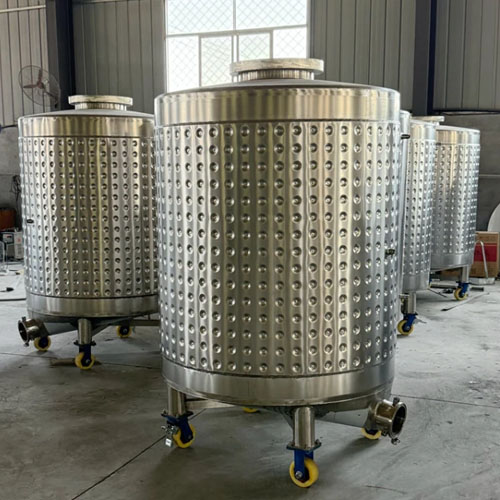
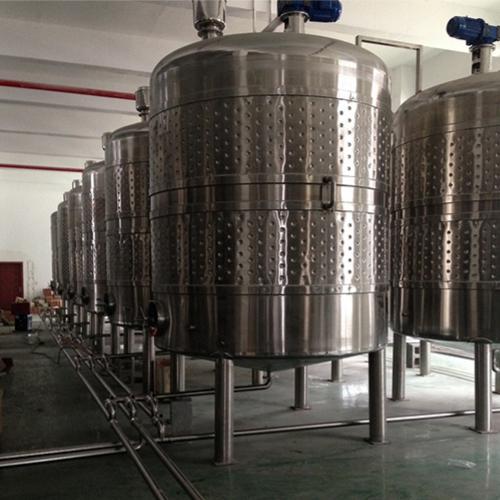
The “L” matters here specifically. Low carbon (0.03% max vs 0.08% in standard 316) prevents sensitization — the process where carbon bonds with chromium at the weld, depleting the corrosion resistance right at the seam. A fermenter has a lot of welds (dimple jacket, manway, fittings). 316L keeps those seams corrosion-free, which is why it’s the de facto standard for commercial fermenters that see any real abuse.
Don’t Skip the Surface Finish
Grade gets the attention, but finish is what your beer actually touches. A rough surface traps biofilm; a smooth one lets CIP do its job.
| Finish | Roughness (Ra) | Use |
|---|---|---|
| 2B (cold-rolled, bright) | 0.2–0.5 μm | General food tanks, cost-effective default |
| No. 4 (brushed) | 0.3–0.6 μm | Visible, easy-clean surfaces |
| Electropolished | 0.05–0.20 μm | Brewery/dairy contact surfaces, biofilm-critical |
We’ve watched a Shanghai OEM approve a budget 2B plate, hit biofilm buildup after three cycles, rip out the CIP system, and switch to electropolished 304 at Ra ≤ 0.4 μm — which cut CIP cycle time 35% and killed the biofilm problem. The grade was right; the finish was wrong. For fermenters and bright tanks, electropolish on the wetted surface is worth the upcharge regardless of 304 vs 316.
One more thing: passivation restores the chromium oxide layer that welding and grinding disrupt. Citric-acid passivation (ASTM A967) is the food-grade standard. Skip it and the weld heat-affected zones will pit and harbor bacteria even on 316L.
The Cost Reality (and Total Cost of Ownership)
On a like-for-like tank, 316L runs roughly 20–50% more than 304. That’s real money on a 20-bbl fermenter order.
But “upfront cost” isn’t “total cost.” The argument for 316L isn’t that it’s cheaper — it’s that replacing a pitted 304 tank at year 12 because you under-specified for your environment costs more than the premium would have. The sensible rule:
- Standard service, no chlorides → 304L. Save the 20–50%.
- Aggressive service (sour, coastal, chlorine CIP) → 316L upfront. It wins on 20-year total cost of ownership.
Buying 304 across the board and hoping is the expensive mistake. So is upgrading every tank to 316L “just to be safe.” Match the grade to the duty.
The Trap: “It’s a 316 Tank” Often Isn’t
Here’s the misconception that costs buyers money. A tank listed as “316” is frequently only partly 316 — the inner shell that contacts product might be 316L, while the outer shell, jacket, and structural bits are 304 or even carbon steel. That’s legitimate engineering (you pay for 316 only where it touches product), but it’s also where quotes get compared apples-to-oranges.
When you spec a tank, ask specifically: which surfaces are 316, and which are 304? A fermenter with a 316L product contact surface and a 304 jacket is a perfectly good tank and a fair price. A “316 tank” that’s 304 everywhere except a thin liner is a different animal. Get it in writing on the spec sheet.
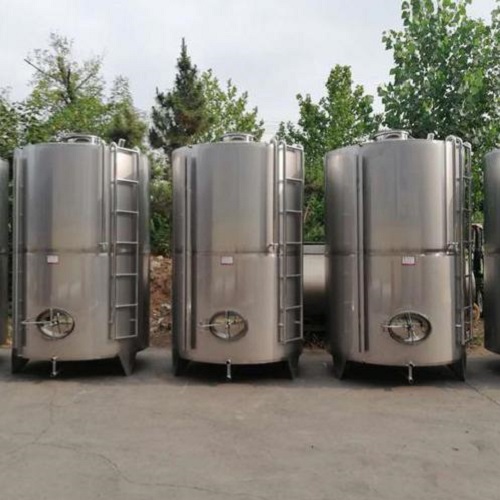
Practical note: most of our stainless steel brewery fermentation tanks are offered in both 304 and 316L contact-surface builds, with the choice left to your duty cycle rather than forced on every order.
Quick Decision Rule
| Your situation | Spec |
|---|---|
| Standard ale/lager, inland water, caustic+acid CIP | 304L |
| Sour / fruited / kettle sour program | 316L (904L for extreme sours) |
| Coastal or high-chloride well water | 316L |
| Chlorine / peracetic CIP sanitizers | 316L |
| Hot, humid, salt-air climate | 316L |
| Any of the above + welded tank | 316L (low carbon mandatory) |
If you can’t tell from this table which bucket you’re in, that’s the one question worth answering before you request quotes — tell us what you brew and where the water comes from, and we’ll spec it.
Why Brewers Spec With Us
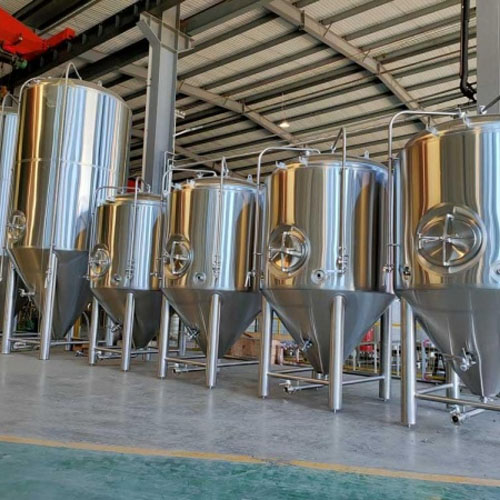
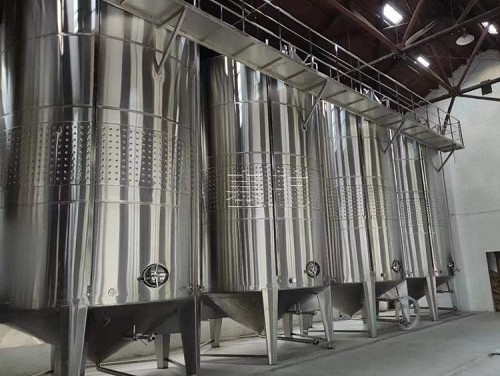
We build beer fermentation tanks and conical fermentation tanks in both 304L and 316L contact-surface configurations, with glycol dimpled jackets (single, dual, or triple zone), electropolished wetted surfaces, and citric-acid passivation as standard. Shell thickness, cone angle, and pressure rating are matched to your batch size and whether you’re running unitank conditioning.
For the full brewhouse, our beer mashing system equipment and jacketed mixing tanks round out the line. Every vessel is built to ISO 9001, and we support drawing-based customization — send us your spec and we’ll match the grade to the duty instead of upselling 316L on a tank that doesn’t need it.
FAQ
For standard ale and lager production on a normal municipal water supply, yes — 304 (or 304L for welded tanks) is the industry default and handles wort pH, fermentation acids, and caustic/acid CIP without issue. Step into sours, fruited beers, coastal locations, or chlorine-based sanitizers and 316L becomes the safer spec.
On a comparable vessel, 316L typically costs 20–50% more than 304. The premium is the molybdenum content and the lower-carbon processing. Whether it pays back depends on your environment: zero-chloride service makes 316L a pure upcharge, while aggressive service makes 304 the expensive choice once pitting starts.
Both resist standard caustic (NaOH) CIP well. The bigger gap is chlorides — 316L’s molybdenum resists chloride pitting that 304 is vulnerable to, especially at weld seams. If your CIP loop is caustic plus phosphoric/nitric acid with no chlorine, 304L holds up fine.
316L at minimum, and for aggressive or long-sour programs some breweries move to 904L or duplex 2205. Sour and fruited beers drop pH well below standard beer and add acids and salts that accelerate pitting on 304 — exactly the duty 316L’s molybdenum is there to handle.
The “L” means low carbon (0.03% max vs 0.08% in standard grades). Low carbon prevents sensitization — chromium carbide forming at welds and stripping corrosion resistance from the seam. For a welded fermenter with dimple jackets and many fittings, 316L (or 304L) is the correct choice over non-L grades.
For tanks that see salt air or high-chloride water, 316L on the product-contact surface is the right call — 304 will pit faster in that environment, starting at fittings and weld seams. Indoor structural and jacket components can stay 304 to control cost, as long as the wetted surface is 316L.
Yes, and it’s common. A typical build uses 316L on the inner product-contact shell and 304 on the outer shell, jacket, and structure. You pay the 316 premium only where it touches beer. Just confirm the split in writing on the spec sheet so quotes compare fairly.
Answer three things: what do you brew (standard vs sour/fruited), where’s your water from (municipal inland vs coastal/well), and what’s in your CIP loop (caustic+acid vs chlorine compounds). Standard + inland + no chlorine = 304L. Anything aggressive in those three = 316L. If you’re unsure, send us the details and we’ll spec it.
Wanzhi Machinery builds stainless steel brewery tanks in 304L and 316L contact-surface configurations for breweries in 100+ countries. Talk to our engineering team about matching the grade to your duty cycle — we’d rather spec the right tank than upsell the expensive one.
Inquiry Form
Latest Articles
Conical Wine Fermentation Tanks
5000L Stainless Steel Storage Tanks
Stainless Steel Floating Roof Tank
Stainless Steel Wine Cold Stabilizer Tank
Stainless Steel Wine Storage Tanks
Latest Products
Product Categories
Colloid Mill
- Vertical Colloid Mill
- Split Colloid Mill
- Horizontal Colloid Mill
- Commercial Peanut Butter Machine
- Tahini Machine
- Chili Sauce Grinder
- Nut Butter Grinder
Stainless Steel Tank
- Milk Cooling Tank
- Stainless Steel Mixing Tank
- Cylindrical Stainless Steel Insulated Water Tank
- Horizontal Stainless Steel Water Tank
- Vertical Stainless Steel Water Storage Tank
- Stainless Steel Reactor
- Conical Fermentation Tank
Extraction Machine
Filling Machines
Tomato sauce Production Line
Contact Us
- Mobile/Wechat: +8618595716541
- Whatsapp: +8618736065220
- Email: info04@wanzhisteel.com
- Address: 10F, Building B, Erqi Center, Erqi District, Zhengzhou City, Henan Province, China