
Stainless Steel Vertical Cooling Tank
Introduction
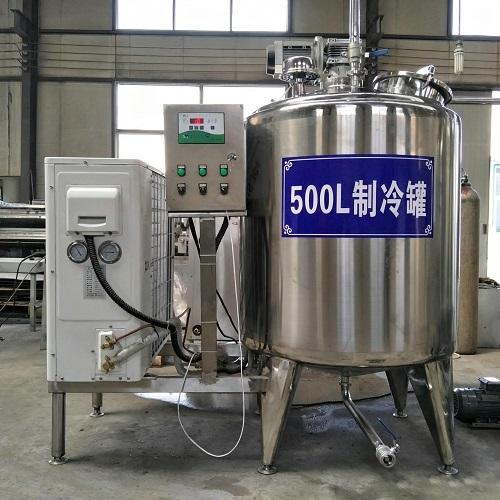
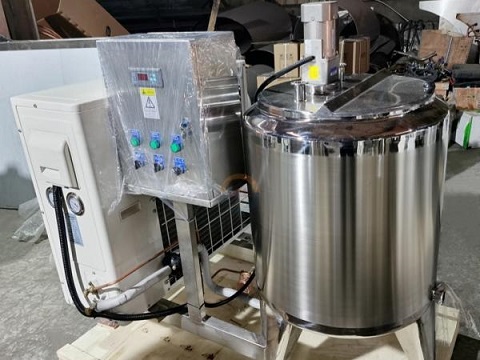
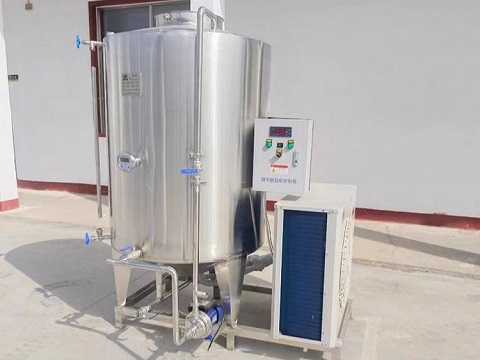
A stainless steel vertical cooling tank—most commonly known in the dairy world as a vertical milk cooling tank or direct-cooling milk tank—is a hygienic, upright, refrigerated vessel used to rapidly chill and store raw milk (or other temperature-sensitive liquids) at the farm, milk collection center, or dairy plant. Its defining feature is a vertical, space-saving footprint combined with a built-in refrigeration system that pulls fresh milk from cow-body temperature (~35–38 °C) down to a safe 4 °C within hours and holds it there.
The stainless steel vertical cooling tank is a freestanding, insulated, sanitary-grade tank with an integrated direct-expansion refrigeration jacket/evaporator and agitator that cools and stores liquid food products—above all milk—while preventing bacterial growth.
What Is a Stainless Steel Vertical Cooling Tank?
The vertical cooling tank is the standard chilling and holding vessel for the dairy chain. Also called a vertical milk cooling tank, direct-cooling milk tank, or—at very large volumes—a vertical milk cooling silo, it performs two jobs in one unit:
- Rapid cooling of raw milk immediately after milking, so bacteria cannot multiply and the milk stays at “Grade A” quality.
- Hygienic storage at a constant low temperature until collection or processing.
Compared with horizontal tanks, the vertical design maximizes capacity per floor area, which is why it dominates farms, collection points, and—at silo scale—plants where space is constrained. The tank body, agitator, refrigeration unit, and electrical control system form an integrated, often single-chassis package.
Types of Stainless Steel Vertical Cooling Tanks (by Capacity)
The equipment spans three capacity tiers, each with different engineering:
1. Farm / small vertical tanks — 300 to 2,000 L
Single integrated chassis, direct-cooling wall, 25 W mixer, capacities of 300 / 500 / 1,000 / 1,500 / 2,000 L. Ideal for individual farms and small collection points. Refrigerant R-404A; cools 35–38 °C → 4 °C quickly.
2. Medium vertical tanks — 3,000 to 10,000 L
Larger direct-cooling wall area, 5–21 kW compressor, recommended for collection stations and small dairies.
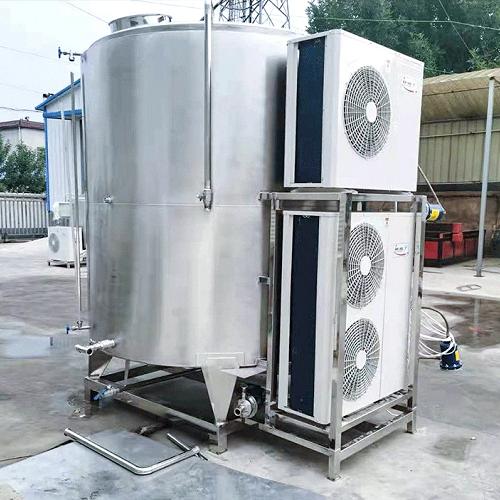
3. Vertical milk cooling silo — 5,000 L or more
Large-footprint silo for plants and robotic-milking operations where floor space is limited. Delivered as a complete package: separated cooling unit (conventional or robotic) + pre-mounted control system (e.g., Argos), offered in two diameters for siting flexibility. Uses R744 (CO₂) refrigerant, thick top/bottom/side insulation, and optional heat recovery. No large indoor milk room required—placed outside.
Technical parameters:
Product Specifications
| Volume(L) | Compressor(P) | Stirring speed(r/min) | Refrigeration unit | Refrigeration agent | Length × Width × Height (mm) |
|---|---|---|---|---|---|
| 300 | 2.5 | 36 | SANYO COPLAND | R-404a/R-22 | 1700×900×1550 |
| 500 | 2.5 | 36 | 1800×1000×1850 | ||
| 1000 | 3 | 36 | 1680×1210×1300 | ||
| 2000 | 5 | 36 | 2050×1500×1500 | ||
| 3000 | 6 | 36 | 2380×1700×1600 | ||
| 4000 | 8 | 36 | 2630×1800×1700 | ||
| 5000 | 10 | 36 | 2980×1900×1800 | ||
| 6000 | 12 | 36 | 3080×2100×1950 | ||
| 7000 | 12 | 36 | 3300×2100×1950 |
Small / medium vertical milk cooling tank (300–2,000 L)
| Parameter | Typical value |
|---|---|
| Capacities | 300, 500, 1,000, 1,500, 2,000 L |
| Inner wall | 1.5 mm CrNi 304 stainless steel |
| Outer wall | ~1.0 mm SUS304 |
| Evaporator | 2 mm inner wall + laser-welded roll-bond plate |
| Insulation | 50 mm high-density PU (HCFC-free) |
| Agitator | 25 W, 36 rpm reducer, SS blades |
| Refrigerant | R-404A |
| Cooling performance | 35–38 °C → 4 °C rapid, frost-free |
| Electrical | IP65 panel, 220–380 V, digital control |
| Lid | One-piece spring-loaded, Ø200 mm inlet |
| Drainage | Butterfly valve, zero residue |

Large vertical milk cooling silo (5,000 L or more)
| Parameter | Typical value |
|---|---|
| Capacity range | 5,000 – 50,000 L |
| Diameters | Two diameters available |
| Material | High-quality stainless steel |
| Insulation | Thick PU on bottom, top, and side walls |
| Refrigerant | R744 (CO₂) — eco-friendly, high efficiency |
| Cooling unit | Separated, for conventional or robotic milking |
| Control | Pre-mounted advanced control unit (Argos-class) |
| Options | Heat recovery (warm cow/cleaning water), many smart add-ons |
| Install | Quick; space-saving outdoor placement |
Refrigerants & Energy Efficiency
- R-404A – common on 300–2,000 L tanks; reliable, frost-free rapid cooling.
- R744 (CO₂) – used on large silos; one of the lowest-GWP, most efficient refrigerants; pairs with heat recovery.
- Insulation matters – 50–80 mm PU on all walls protects the compressor, lowers runtime, and extends equipment life.
- Heat recovery – capturing milk heat for farm hot water can cut a dairy’s energy bill materially.
Material Grades: 304 vs. 316L
| Factor | SUS304 | SUS316L |
|---|---|---|
| Corrosion resistance | Excellent for milk, water, most food | Superior; resists chlorides/sanitizers |
| Cost | Standard | Higher |
| Use case | Standard milk, juice, beverage cooling | Coastal/high-salt wash, pharmaceutical-grade |
Rule: 304 is the dairy default; choose 316L inner shell where aggressive cleaning chemicals or salty conditions demand extra life.
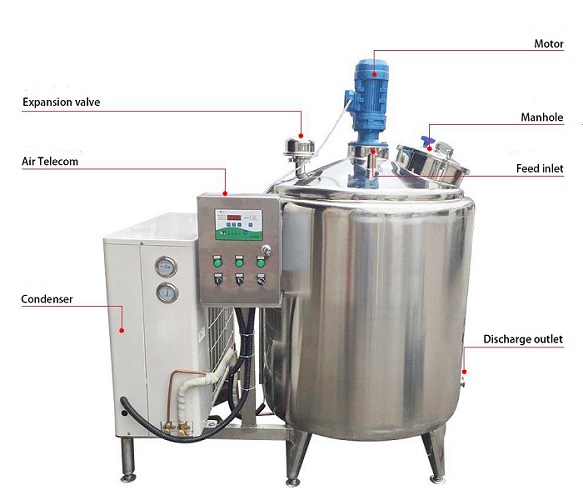
Core Components of a Vertical Cooling Tank
| # | Component (EN) | Function |
|---|---|---|
| 1 | Tank shell (inner) | SUS304 (or 316L) stainless steel, polished; holds the product |
| 2 | Direct-cooling evaporator | Laser-welded roll-bond plate / jacket in the wall; transfers refrigeration to product |
| 3 | Insulation | 50–80 mm high-density polyurethane (HCFC-free); minimizes heat gain |
| 4 | Outer cladding | SUS304 stainless steel skin (typically ~1 mm) |
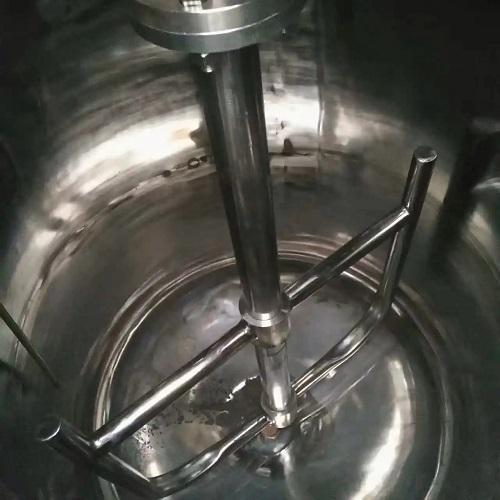
| 5 | Agitator | 25 W–3 kW reducer motor, 28–36 rpm, stainless-steel blades |
| 6 | Refrigeration unit | Compressor (Copeland / Tecumseh / Maneurop class), condenser, refrigerant circuit |
| 7 | Control panel | IP65-rated; digital thermometer, automatic mixing program, fault alarm |
| 8 | CIP spray ball | Rotating cleaning head for automated wash-in-place |
| 9 | Lid & inlet | Spring-loaded one-piece lid; Ø200 mm product inlet |
| 10 | Outlet & feet | Butterfly drain valve (zero-residue); height-adjustable legs |
How a Stainless Steel Vertical Cooling Tank Works?
The cooling principle is direct-expansion (direct cooling): a refrigerant evaporator is built directly into the tank wall (a laser-welded “roll-bond” plate or a direct-cooling jacket), so the cold is transferred straight to the milk with no intermediate fluid. The cycle:
- Milking – warm milk (35–38 °C) flows in through the top inlet.
- Refrigeration – the compressor circulates refrigerant (R-404A or, on newer eco units, R744/CO₂) through the wall evaporator; heat is pulled out of the milk.
- Agitation – a low-speed mixer (typically 28–36 rpm) keeps the milk moving so cooling is uniform and fat does not separate; many units start the mixer automatically once milk reaches a set level.
- Holding – once the milk hits ~4 °C, the controller holds temperature; thick PU insulation keeps the loss to roughly ≤1 °C per 3 hours when idle.
- Discharge – a bottom butterfly valve drains the tank; good designs leave zero liquid residue.
Eco note: premium silos (e.g., 5,000–50,000 L) now use R744 (CO₂) refrigerant and offer heat-recovery options that capture the removed milk heat to warm cow drinking water or cleaning water—cutting energy cost and emissions.

Applications
A stainless steel vertical cooling tank is the backbone of cold-chain liquid handling:
- Dairy farms – bulk cooling of raw milk to 4 °C at the parlor.
- Milk collection centers / stations – aggregating milk from many farms.
- Dairy plants – silo-scale holding before pasteurization (pair with a stainless steel fermentation tank for cultured products).
- Beverage & juice – chilling and holding fruit juices and drinks.
- Wine / fruit wine – lowering must or wine to storage temperature.
- Pharma & food liquids – any pumpable, temperature-sensitive fluid needing hygienic cooling and storage.
For heated mixing duties upstream or downstream, see the jacketed stainless steel mixing tank or the electric heating jacketed kettle. Browse the full stainless steel tank range for compatible hygienic vessels, and the colloid mill for particle-size reduction after cooling.

How to Choose the Right Vertical Cooling Tank
Provide these parameters to size correctly:
- Daily volume – liters per milking / per day (drives capacity tier).
- Milking system – conventional vs. robotic (affects silo control spec).
- Cooling target – typically 4 °C from 35–38 °C inlet.
- Power supply – 220 V or 380 V availability.
- Space – floor area → vertical vs. silo, diameter choice.
- Material grade – 304 standard, 316L for harsh duty.
- Refrigerant preference – R-404A standard; R744/CO₂ for eco targets.
- Options – CIP, heat recovery, remote monitoring, extra inlets.
- Certifications – ISO 9001, CE, or market-specific marks.
Installation, Cleaning & Maintenance
- CIP-ready – run the rotating spray ball between every batch; full drain (zero residue) simplifies sanitation.
- Daily – verify temperature hold (≤1 °C/3 h drift), check mixer, confirm drain closure.
- Weekly – inspect lid seal, inlet cover, butterfly valve, and electrical panel.
- Monthly – clean condenser coils, check refrigerant lines, verify agitator coupling.
- Annually – compressor service, insulation integrity check, calibration of thermometer/controller.
Why Source From Wanzhi Machinery
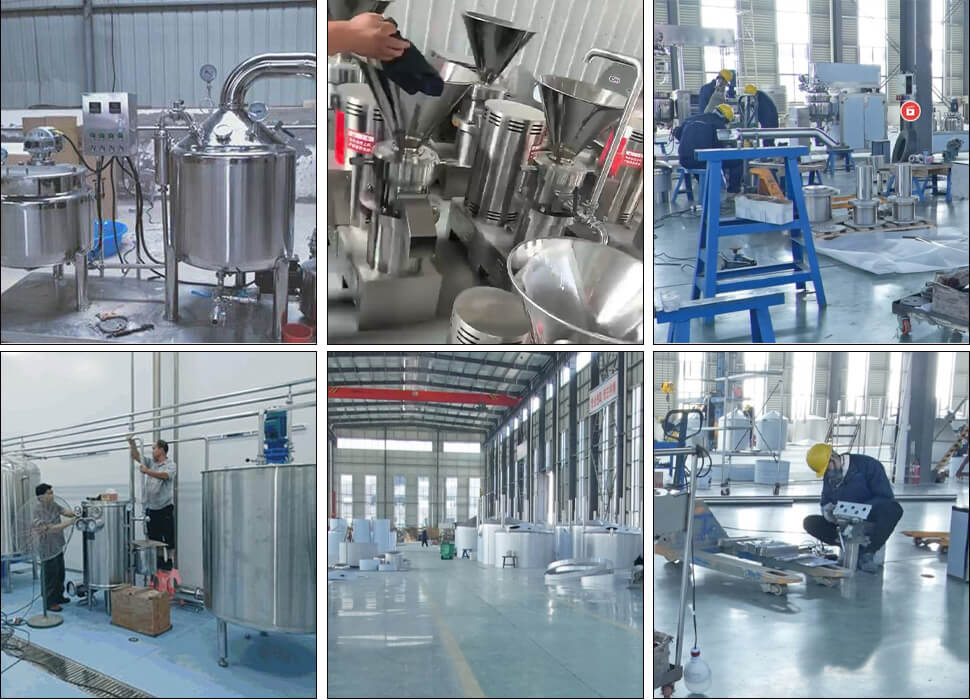
Wanzhi Machinery (wz-mach.com) builds hygienic stainless steel process tanks—including vertical cooling tanks—to ISO 9001 and CE standards, with 15+ years of export experience to 100+ countries. We supply SUS304/316L tanks with direct-cooling evaporators, imported-class compressors, PU insulation, CIP, and automatic agitation, in capacities from 300 L farm units up to large silos, each FAT-tested before shipment.
Tell us your daily volume, power supply, and site constraints, and our engineering team will specify a stainless steel vertical cooling tank—farm unit or silo—with the right compressor, insulation, and control package. Contact Wanzhi Machinery for a tailored quotation.
Frequently Asked Questions
A: A vertical tank stands upright and uses far less floor area for the same volume, making it the default for farms and space-limited sites; horizontal tanks spread out and suit very low-clearance rooms. Both use the same direct-cooling principle.
A: Quality units pull milk from 35–38 °C down to 4 °C rapidly and frost-free—within a few hours for typical farm volumes—then hold it. Thick insulation keeps drift to about ≤1 °C per 3 hours when idle.
A: Small and medium tanks typically use R-404A. Large silos increasingly use R744 (CO₂), a low-GWP, high-efficiency refrigerant, often with heat-recovery to warm farm water.
A: Farm/small tanks run 300–2,000 L; medium 3,000–10,000 L; vertical silos 5,000–50,000 L.
A: SUS304 is the dairy standard and cost-effective. Choose SUS316L for coastal, high-salt wash-down, or pharmaceutical-grade duty where extra corrosion resistance pays off.
A: Yes. The same hygienic vertical cooling tank chills and stores juice, wine/must, and other temperature-sensitive food or pharma liquids.
Related Products
Stainless Steel Pressure Water Tanks
Stainless Steel Pressure Water Tanks Horizontal stainless steel pressure tank Introduction Stainless steel pressure water…
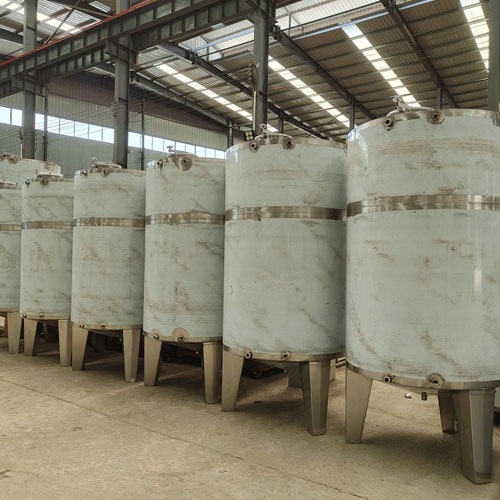
Stainless Steel Edible Oil Storage Tanks
Stainless Steel Edible Oil Storage Tanks Stainless steel edible oil storage tank Introduction Commercial stainless…
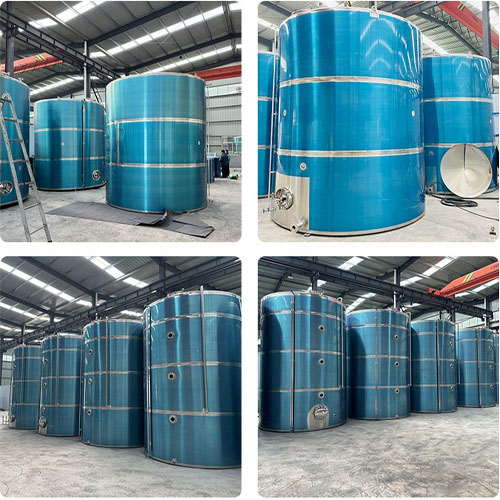
Stainless Steel Olive Oil Storage Tanks
Stainless Steel Olive Oil Storage Tanks Large stainless steel oil storage tank Introduction We supply…
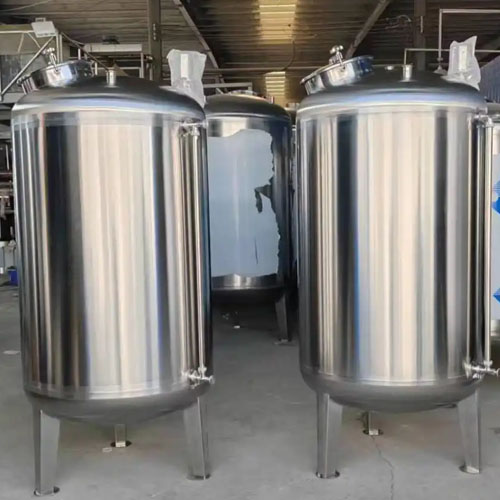
304 Stainless Steel Water Tank
304 Stainless Steel Water Tank 304 stainless steel water tank Introduction Our 304 stainless steel…
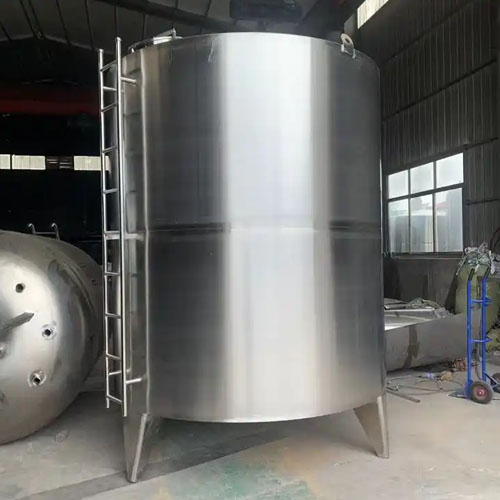
5000L Stainless Steel Storage Tanks
5000L Stainless Steel Storage Tanks 5000L Stainless Steel Storage Tank Introduction Our 5,000-liter stainless steel…
Contact Us