
Sesame grinding machine for tahini: bench grinder or colloid mill
what tahini needs from a grinder
Tahini is a paste of crushed sesame seeds, used across Middle Eastern cooking in hummus, taratoor and baba ghanoush. Britannica puts the fixed oil content of the seed at roughly 44 to 60 percent, which is what makes a smooth paste possible and what makes it hard to keep stable.
Grinding sesame involves more than size reduction. The oil has to be worked into the solids so the paste does not settle into a firm layer with oil on top. Wanzhi’s tahini grinder page describes a shearing and emulsifying action that forces oil and solids together, and states the finished paste stays stable for 30 days without added stabilizer.
That requirement shapes the machine choice. You need enough shear to break the seed, control over temperature so the aroma survives, and a flow path that keeps paste moving instead of packing into the grinding zone.
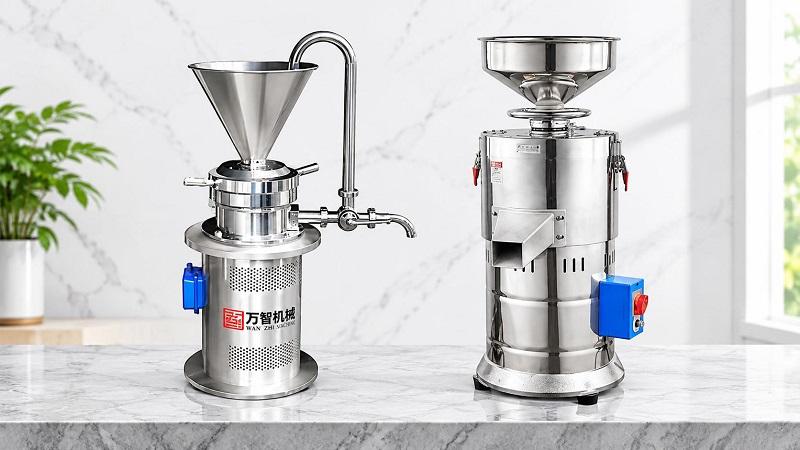
two designs that make sesame paste
Two builds on this site turn sesame into tahini, and they use different mechanisms.
the emery wheel route
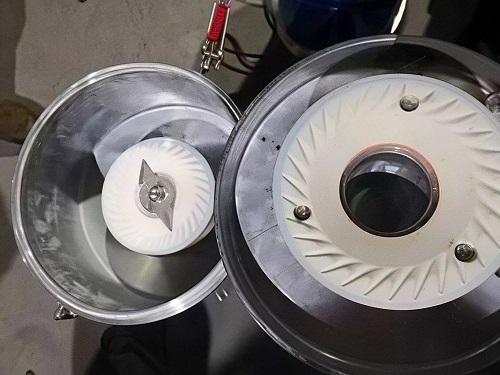
The XM series spins a food-grade emery wheel against a fixed ring. Seeds drop from a top hopper, get sheared between wheel and ring, and leave through a bottom outlet by gravity. The shell is aluminum alloy, so the unit sits on a bench and moves between stations. No conveyor feeds it, and one operator keeps the hopper topped up.
the rotor-stator route
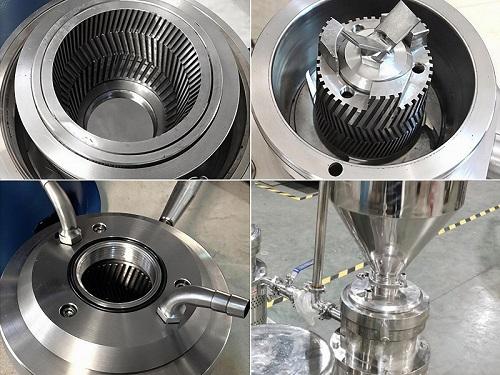
The colloid mill turns a rotor at high speed against a stationary stator with an adjustable micron gap. Pre-treated seeds enter at the feed port and pass through that gap, where shear, friction and high-frequency vibration break them down and blend the oil into the solids. Centrifugal force and incoming material push the paste out of the discharge port.
Both builds make tahini. Volume and layout split them: XM units are bench machines for shops, while colloid mills are built for continuous runs and line integration. The grinding machine category lists both families in one place.
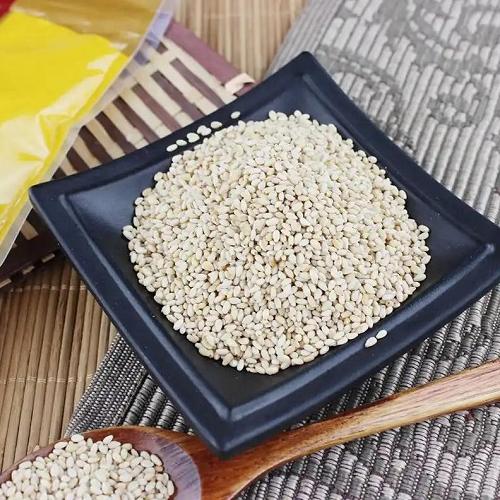
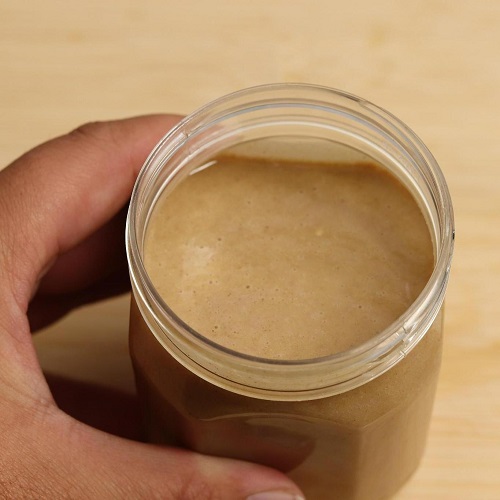
the XM bench grinder for small batches
Three XM models share the wheel-and-ring design and a 2800 r/min drive.
| Model | Power | Output | Fineness | Wheel | Dimensions (mm) | Weight |
| XM100 | 1.1 kW | 15 kg/h | 0.1 um | 100 mm | 300 x 300 x 700 | 25 kg |
| XM160 | 1.5 kW | 35 kg/h | 0.07 um | 160 mm | 330 x 330 x 800 | 40 kg |
| XM200 | 2.2 kW | 45 kg/h | 0.05 um | 200 mm | 370 x 370 x 820 | 45 kg |
Small cafes and condiment stalls making a few kilos a day fit the XM100. Selling by the jar pushes most buyers to the XM160, and the XM200 suits workshops supplying several shops. The larger wheel gives a finer result on the spec sheet, which matters for a silky sesame paste.
Leave space under the outlet for the catch container. Our sesame peanut butter machine guide walks through the working principle and the model choice in more detail.
the JML colloid mill for tahini
The tahini page names the vertical colloid mill as the most commonly used and ideal mill for sesame paste. Four vertical JML models are listed there.
| Model | Fineness | Output | Power | Dimensions (mm) | Weight |
| JML-80 | 2-40 um | 300-1000 kg/h | 3 kW | 360 x 360 x 820 | 80 kg |
| JML-100 | 2-40 um | 500-2000 kg/h | 5.5 kW | 410 x 410 x 960 | 135 kg |
| JML-120 | 2-40 um | 700-3000 kg/h | 7.5 kW | 410 x 410 x 960 | 150 kg |
| JML-140 | 2-40 um | 1000-4000 kg/h | 11 kW | 500 x 500 x 1160 | 230 kg |
All four run on 380V. The tahini page also quotes a family range of 10 to 15,000 kg/h and 100 to 600 mesh, so check which figure belongs to the configuration you are quoted before you compare offers.
Every food-contact part is 304 stainless steel, grinding discs included. The page gives 10 to 23 um for those discs and lists an optional cooling system that holds the grinding temperature down when sesame runs in hot weather.
matching the machine to daily output
The tahini page groups three setups by daily volume. These are the supplier’s own combinations and a fair starting point for a first inquiry.
| Buyer | Daily output | Suggested setup |
| Small workshop | 50-200 kg | Single machine, small sesame washing and roasting machine, manual filler |
| Medium factory | 500-2000 kg | Coarse and fine mill in series, automatic loading, filtering device |
| Large food plant | 5000 kg or more | Multi-machine line, PLC control, automatic filler, sterilization equipment |
One JML-80 at 300 to 1000 kg/h covers most small workshops with room to spare. Running two mills in series is the step up for a factory that wants a coarse pass followed by a fine one, and the page pairs that with automatic loading and a filter.
Past 5000 kg a day the discussion moves from a single machine to a line. Our colloid mill category shows the builds that carry that volume. For the XM range, the practical ceiling stays near 45 kg/h.
choosing the colloid mill layout
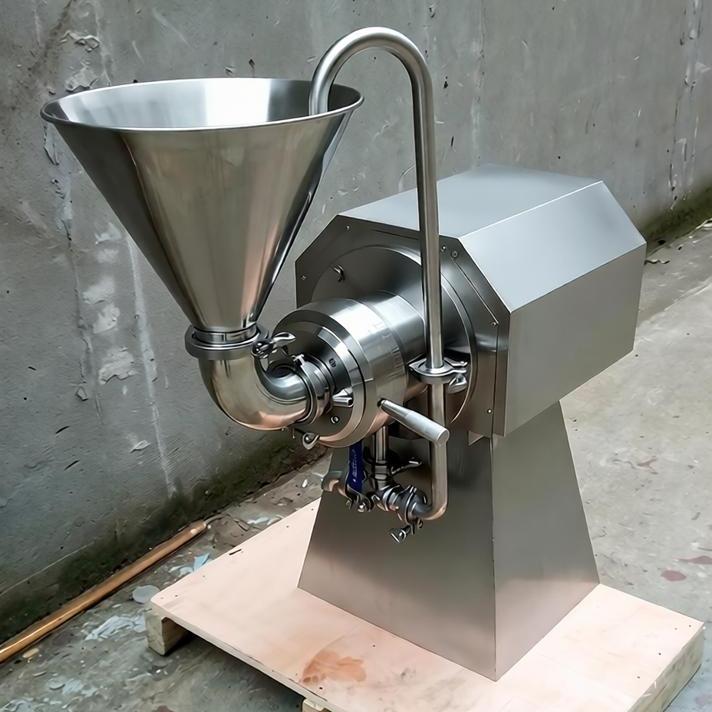
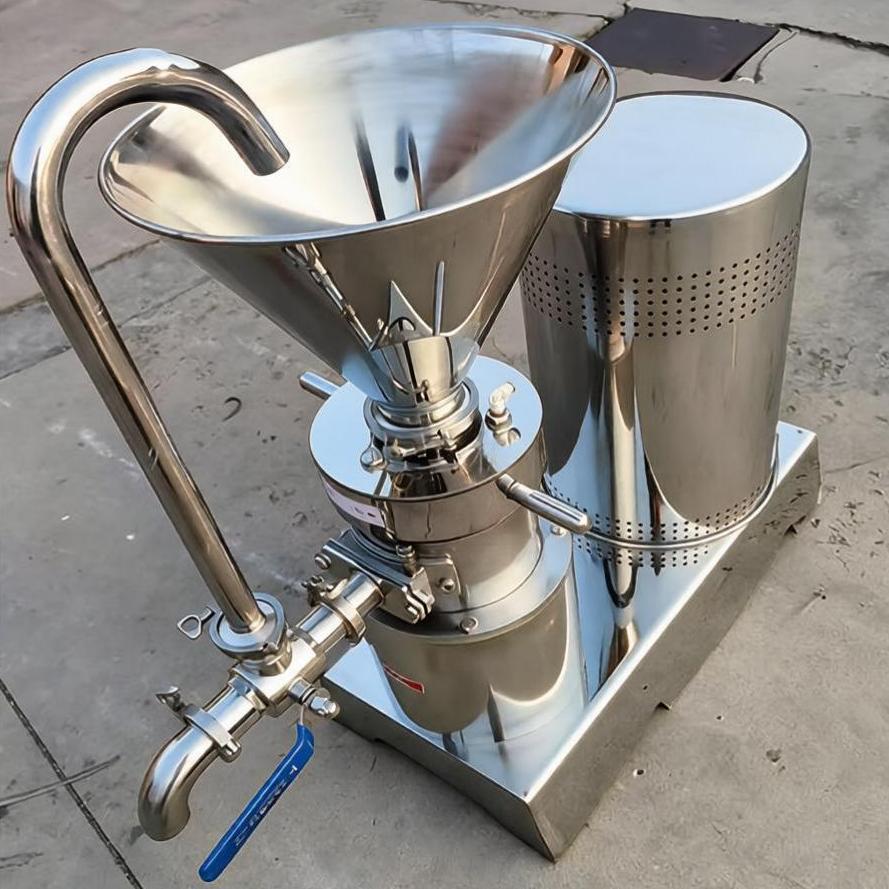
Above bench scale, three layouts are available. The tahini page recommends the vertical mill for sesame paste. Horizontal and split builds also appear for sesame paste in our layout guide, which points them at high-viscosity or long continuous work, so the decision depends on how long and how thick you run.
Vertical mills put motor and head in one compact column. They take the least floor space and cost less, but the seal sits at the bottom and head maintenance can mean lifting the whole assembly. Horizontal mills mount the stator and rotor side by side, with a side seal and sliding-head access; they need more floor area and a delivery pump.
Split mills keep motor and grinding head apart on a belt drive. That stops motor heat reaching the paste, suits long continuous runs, and lets the disc come off for cleaning without the motor. Our layout comparison guide sets out the trade-offs in full.
Specific builds: vertical, horizontal and split.
fineness, mesh and oil separation
Fineness figures on this site come from different product pages and different units, so treat each as page-specific rather than one comparable scale.
The XM table states 0.1, 0.07 and 0.05 um for its three models. On the colloid mill side, the JML table states 2 to 40 um, while the tahini page gives 100 to 600 mesh and 10 to 23 um for the grinding discs. No measurement basis is printed on those pages, so we do not convert the numbers into a single ranking or claim one build is finer than the other.
The tahini page does tie fineness to a practical result. It says high-frequency vibration and forced emulsification blend oil and solids, with 30-day stability and no added stabilizer. The same page also lists optional cooling to protect aroma and avoid protein denaturation, plus a flow path meant to stop thick paste from clogging.
Ask for a trial with your own seeds before you fix a fineness target. Roasting and cooling change the outcome as much as the gap setting.
steel and cleaning between recipes
Food-contact parts on the colloid mills are 304 stainless steel. Our sister mill Wanzhi Steel describes 304 as an austenitic 18/8 grade used in food processing equipment, which is why it is specified for surfaces the paste touches.
The tahini page states that chamber, inlet and outlet disassemble and rinse under a high-pressure water jet within 15 minutes. That matters when you switch from sesame to peanut or almond, since leftover seed oil carries flavor into the next batch.
Our colloid mill cleaning guide covers daily CIP and deep teardown, including warm water with food-grade detergent circulated for 15 to 20 minutes and a final rinse until the water runs clear. A plant cleaning several vessels can look at a CIP cleaning tank for the pipework.
The XM bench grinder uses a simpler routine. Rinse the wheel, hopper and outlet by hand before a recipe change.
what to tell us before you order
A quote depends on more than a model number. Give us the details that decide mill size and the layout around it.
Start with daily output in kilograms and the hours you actually run. Add the condition of the seed when it reaches the mill: cleaned and roasted, cooled, and whether any pre-crushing happens upstream. Name the target container and filling method, since a manual filler and a piston filler change the line.
List the voltage and frequency at your site. The JML table states 380V, and the XM page asks buyers to confirm voltage and plug type locally. Say whether you need the optional cooling system and whether sesame is the only recipe or one of several.
Our contact page takes those details. For volume above the XM range, the tahini grinder page carries the full parameter table and the three line combinations.
FAQ
It depends on daily volume. Bench XM units suit 15 to 45 kg/h. JML vertical colloid mills start at 300 kg/h and reach 4000 kg/h.
A food-grade emery wheel grinds roasted seeds, and a finer setting gives a smoother paste. One machine also handles peanut butter after cleaning.
Which colloid mill is used for sesame past
The tahini page names the vertical mill as the most common choice. Horizontal and split mills also list sesame paste, and suit high-viscosity or long continuous runs.
The source pages quote 2 to 40 um for JML mills, 10 to 23 um for the discs and 100 to 600 mesh. They give no common basis, so we do not convert between them.
The tahini page offers optional cooling to control grinding temperature, protect aroma and avoid protein denaturation in hot weather.
Yes, on both routes. Wash the contact parts between recipes so oil and flavor do not carry over.
talk to us about your tahini line
Choosing between a bench grinder and a colloid mill gets easier once we know your daily output, seed preparation and site voltage.
Wanzhi Machinery supplies XM bench grinders, JML vertical mills and the horizontal and split builds that carry larger lines, with 304 stainless steel on colloid mill food-contact parts. Send your figures to our team for a model recommendation and a line layout.
Inquiry Form
Latest Articles
Sesame Grinding Machine for Tahini: How to Choose
Meatball Former for Fish Balls and Meat Paste
Meatball forming machine how to choose
Horizontal vs Vertical Stainless Steel Tank
Sesame Peanut Butter Machine
Latest Products
Product Categories
Stainless Steel Tank
- Stainless Steel Wine Tanks
- Stainless Steel Water Storage Tank
- Stainless Steel Fermentation Tanks
- Stainless Steel Jacketed Kettle
- Pasteurizing Machine
Meat Processing Machine
Fruit and VegetableProcessing Machinery
Oil Press Machines
Grinding Machine
Extraction Machine
Packaging Machinery
Contact Us
- Mobile/Wechat: +8618595716541
- Whatsapp: +8618736065220
- Email: info04@wanzhisteel.com
- Address: 10F, Building B, Erqi Center, Erqi District, Zhengzhou City, Henan Province, China