
Meatball Forming Machine: How to Choose
what you are actually choosing between
Buyers comparing meatball forming machines usually arrive with a daily output figure and a product list, then find two machines that look much alike in a photo. Our meatball forming machine range has two live builds, and they solve different problems. The commercial meatball forming machine is the WZ-605 family, a compact unit rated in kilograms per hour. WZ-702, the dual-speed meatball forming machine, is a taller vertical machine rated in meatballs per minute, with two motors you set separately.
Both run on 220V or 380V, and both push a prepared paste through a die before a blade cuts it into balls. Neither machine grinds whole cuts or cooks the product. Grinding, cooking and packing sit elsewhere in the flow, which our meat processing solutions page describes from rough cutting through to backend packaging. Start with the output units, because that column is where most wrong orders begin: one model is measured by weight per hour, the other by count per minute.
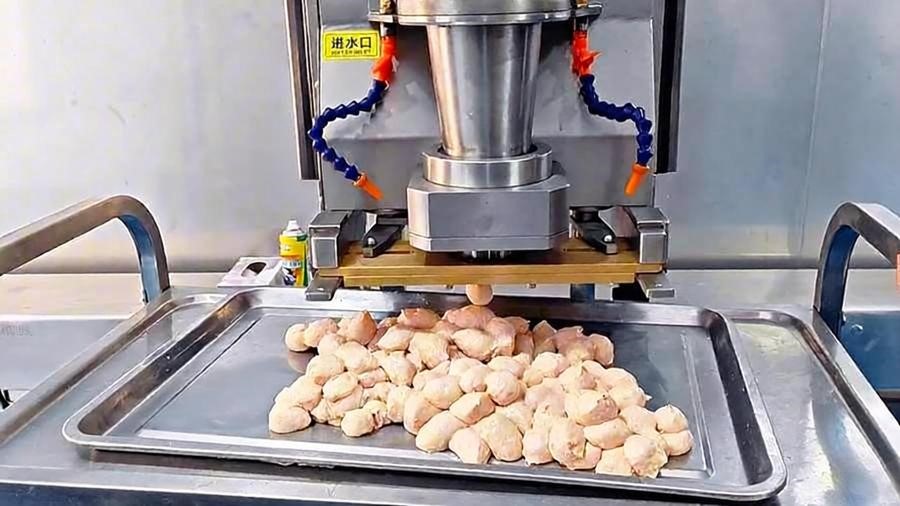
start with output, not with the motor
Capacity is the first filter. Our commercial meatball forming machine table lists three versions: the WZ-605 and its taller frame both at 200 to 300 kg/h on a 1.1 kW motor, and the WZ-605S at 200 to 500 kg/h on 2.2 kW. The dual-speed meatball forming machine WZ-702 is rated at 80 to 500 meatballs per minute on 1.3 kW. Those figures come from the two live product pages and cannot be turned into each other without the weight of one ball, which we do not publish.
| Model | Power | Rated output | Weight | Dimensions |
|---|---|---|---|---|
| WZ-605 | 1.1 kW | 200 to 300 kg/h | 70 kg | 680 x 380 x 1220 mm |
| WZ-605 taller frame | 1.1 kW | 200 to 300 kg/h | 70 kg | 680 x 380 x 1620 mm |
| WZ-605S | 2.2 kW | 200 to 500 kg/h | 115 kg | 780 x 450 x 1610 mm |
| WZ-702 | 1.3 kW | 80 to 500 meatballs/min | about 170 kg | 850 x 480 x 1550 mm |
Match the row to your busiest hour rather than your daily average. Kitchens serving a lunch rush need a burst rate that clears the peak; plants feeding a steaming line need a steady rate that never starves the cooker. Send us the ball diameter you sell and we can put both figures on the same scale before you commit.
ball size and the die set
die range on the WZ-605
Diameter is set by the die, so settle the sizes you sell before anything else. Our commercial meatball forming machine page supports 8 to 30 mm customization and includes several standard molds. Its die system is interchangeable, which is how one machine covers a menu instead of a single product. Order spare molds for every size you run, since a second parcel from China means a line waiting idle.
copper dies on the WZ-702
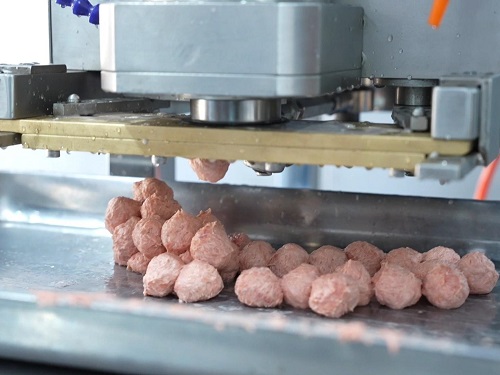
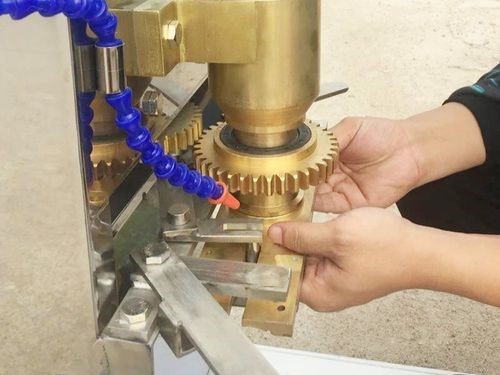
The dual-speed meatball forming machine shapes with a solid copper forming die, and its page gives 10 to 34 mm as the diameter range. It describes the copper as resistant to oxidation and good at carrying heat. Roundness depends on the die and on speed together, so ask for a sample run at the exact diameter you plan to sell rather than judging from a catalog photo.
how the forming action works
one drive, one coordinated cut
The commercial meatball forming machine runs three steps in one pass. Pre-processed paste and seasoning go into a chamber where a mixing device blends and toughens them. A food-grade screw conveyor then carries the mix to the die under steady pressure, which the page says limits air pockets inside the ball. Stainless rotating blades cut the strands, and their speed follows the extrusion rate on its own. There is one speed setting to manage, which suits a kitchen producing the same ball all day.
two motors, two frequency drives
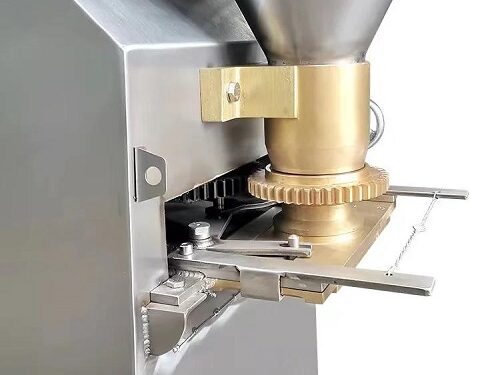
WZ-702 splits the work in two. One motor sets the screw auger feed speed, the other sets how often the forming blade cuts, and each has its own variable frequency drive for stepless adjustment. On the dual-speed meatball forming machine page, high-speed mode runs both fast for bulk orders, while low-speed mode slows extrusion and cutting so the paste is compressed less and comes out denser and more evenly round. Pick this build when product quality changes between runs or when a premium ball sells on texture.
what goes into the hopper
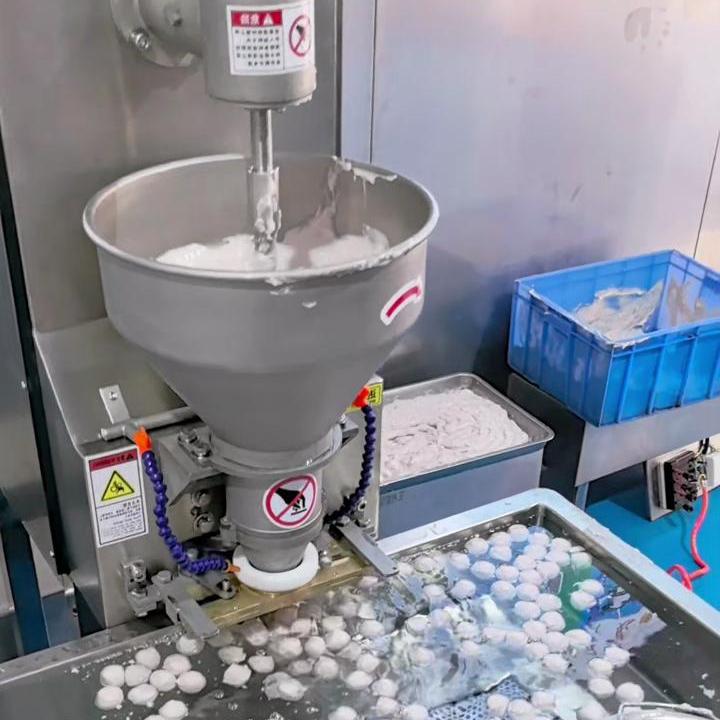
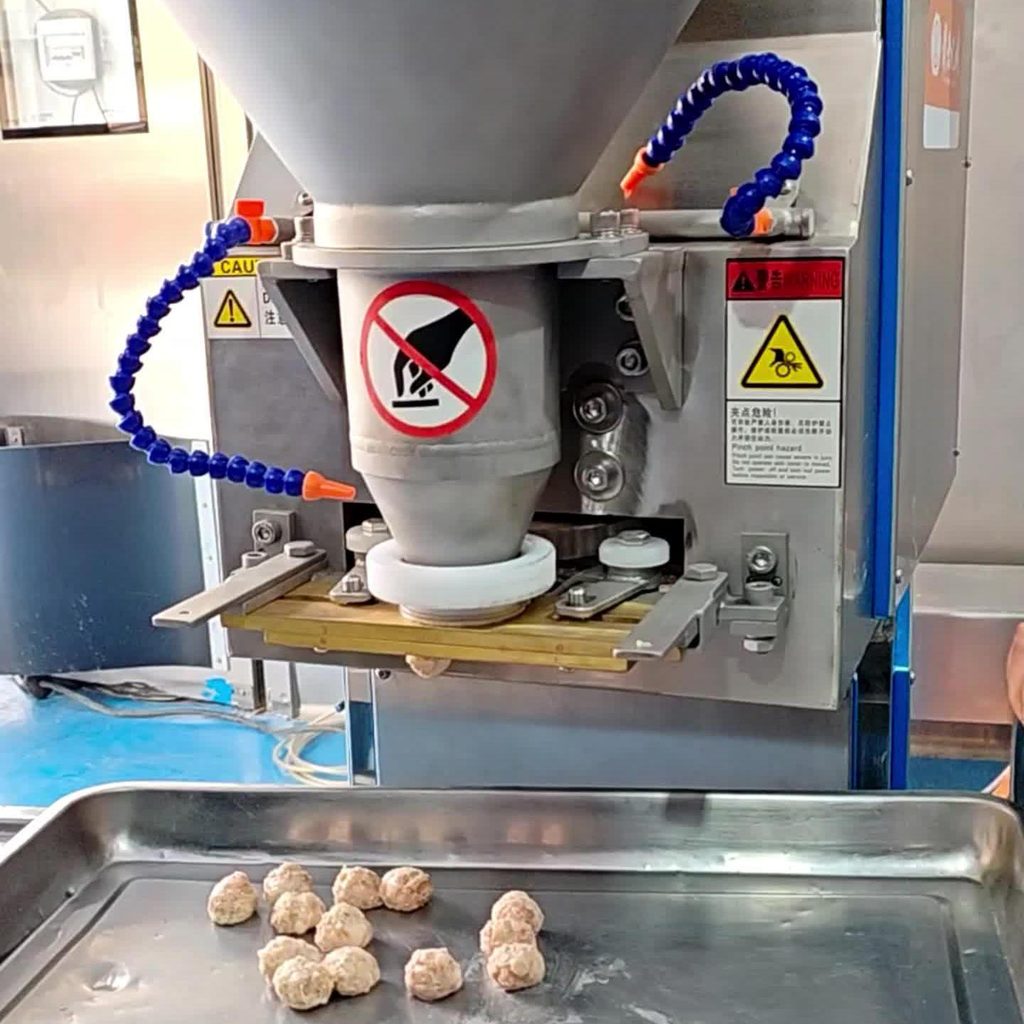
Both machines form a prepared paste rather than whole cuts. The commercial page lists beef, pork, chicken and lamb balls alongside fish, shrimp, squid, peanut and vegetable balls. WZ-702’s own page adds Gongwan and cashew meatballs, plus vegetable and tofu based options, and describes swapping molds and adjusting speed as the way one machine covers several products. Britannica’s meat processing entry describes chopped and seasoned meat as the base for products such as sausages, which is the same family of prepared mix a former portions.
Recipe behavior matters as much as the machine. A loose, high-moisture mix needs a gentler cut, and a dense mix needs more feed pressure, so tell us what goes into your paste when you enquire. Neither product page names a grade for the steel, so ask for that in writing on the quote. Feed evenly and keep foreign objects out of the hopper, as the WZ-702 usage notes instruct.
matching the machine to your site
footprint and weight
Measure the floor and the doorway before you approve a drawing. The WZ-605 takes 680 x 380 mm of floor at 70 kg, and its taller frame keeps that footprint while reaching 1620 mm high. WZ-605S stands at 780 x 450 x 1610 mm and 115 kg. Largest of the four, the WZ-702 measures 850 x 480 x 1550 mm and about 170 kg, so it needs a clear spot and a lifting plan. Our stainless steel meat slicer machine guide makes the same point about checking the space first; one Uzbekistan restaurant ordered a single WZ-S08 because it fit on a bench against the wall.
voltage and the control panel
Every version in the two tables runs on 220V or 380V, so confirm what your panel supplies. The WZ-702 control panel carries speed switches, output control and a safety anti-leakage switch, which an operator will reach for many times a shift. Put the machine where that panel is readable and the outlet is reachable with a tray. Supply voltage is a common reason an order gets held, so send it with the inquiry.
food contact steel and daily cleaning
Contact parts on both builds are described as food-grade stainless steel, with an all-stainless body and hopper on the WZ-702 and a fully stainless frame on the WZ-605. Neither page names a grade, so ask us to state it on the quote if your auditor needs one. Britannica’s stainless steel entry explains the chemistry: chromium at 10 to 30 percent forms the passive film, and the common 304 grade is the 18/8 alloy used in dairy and food processing. Wanzhi Steel lists 304 stainless steel coil for food processing machinery, and its 316 stainless steel sheet page sets out when salt or chlorides push the spec to a molybdenum grade.
daily teardown
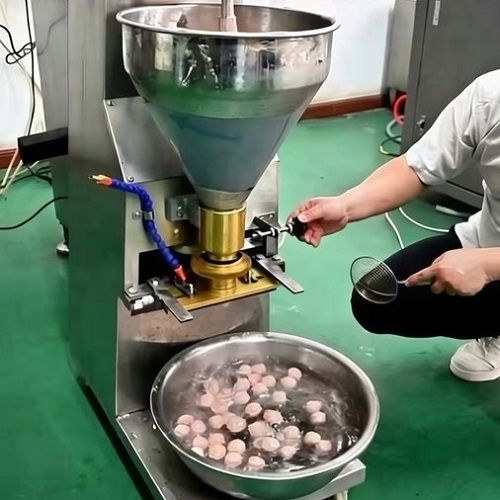
Cleaning is a daily job, not an occasional one. The WZ-702 notes call for a low-speed trial run at start-up and, after each production day, disconnecting power before the hopper, auger and molds come off for washing and drying. Quick-release parts on the WZ-605 serve the same end. FDA safe food handling guidance sets out clean, separate, cook and chill, and lists a safe internal temperature for ground meat. FoodSafety.gov carries the same four steps for small kitchens. The WHO food safety fact sheet frames safe handling as a shared duty along the whole chain, and that puts teardown access ahead of a polished finish.
fitting the former into a line
what feeds the hopper
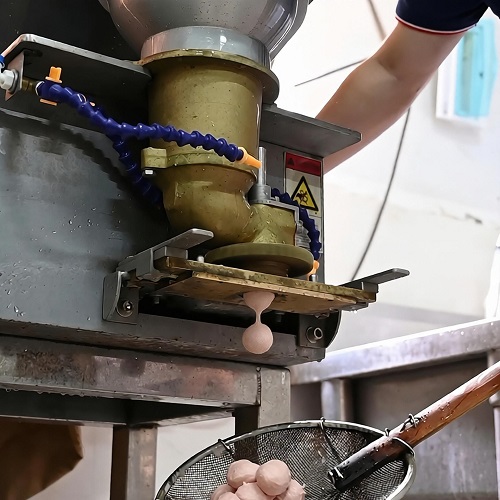
Forming is a middle step. Our meat processing solutions page puts bone saws, meat cutters and meat grinders at the rough processing stage, then high-speed cutters and meatball formers at the forming and emulsifying stage. The WZ-702 page names a meat grinder as its raw material pre-processing equipment. Upstream cutting comes from our meat cutting machine range: the fully automatic meat cube cutter, the meat slicer and dice machine and the large rib cutting machine all prepare cuts before grinding. The meat processing machine category shows those pieces together.
what follows the outlet
Formed balls move on to cooking or steaming. Our commercial page calls the unit part of meatball production lines and meatball steaming lines, and the WZ-702 page shows a steaming and cooking line. Downstream, the WZ-702 page links a rolling vacuum packaging machine for sealing finished meatballs, while the solution page lists vacuum packaging machines and quick-freezing tunnels as the backend options. Britannica notes that vacuum packaging extends refrigerated storage by limiting oxygen. Tell us the outlet height of the next stage and we match the former to it.
a decision table by buyer type
| Buyer | Typical need | Model we would quote | Why |
|---|---|---|---|
| Hot pot or chain restaurant kitchen | steady daily batches of beef and pork balls | WZ-605, 200 to 300 kg/h | one speed setting, small footprint, quick-release cleaning |
| Central kitchen or hotel | several ball sizes across a menu | WZ-605S, 200 to 500 kg/h | interchangeable molds, 8 to 30 mm range, 2.2 kW drive |
| School or corporate cafeteria | bulk supply with occasional small batches | WZ-702, 80 to 500 meatballs/min | high-speed and low-speed modes on one frame |
| Specialty meatball workshop | premium round balls, delicate fillings | WZ-702 | separate feed and cut speeds protect shape and texture |
| Fish ball or seafood plant | fish, shrimp and squid pastes in a cooking line | WZ-605 or WZ-702 by peak rate | matches upstream grinding and downstream steaming |
| Pre-cooked meal factory | formed balls into packing or freezing | WZ-605S or WZ-702 | rated output can be matched to the line before quoting |
Use the left column to find your row, then read across. Two buyers can order the same WZ-605S for different reasons, so we ask for the product list and the peak hour together. The meatball forming machine category and the meat processing machine range show the standard builds if you want to compare first.
what to specify on the quote
Five items settle most selections: the ball diameters you sell, your busiest hour output, the paste recipe, the supply voltage, and a site photo with floor space and doorway width. Die sizes and motor choice follow from the first two. Voltage and footprint follow from the last two. Add the outlet height of any cooking stage if the former will sit in a line.
We do not publish prices on the product pages. Quotes are per configuration, since capacity, mold set, voltage and any line equipment all change the figure. Send those five items through the contact page and our engineers return a model and a die set rather than a catalog sheet.
FAQ
Neither model is better outright. WZ-605 units are compact, rated in kilograms per hour and run one speed setting; the WZ-702 is taller, rated in meatballs per minute and lets you set feed and cutting speed separately.
Size from your busiest hour and tell us the ball diameter you sell. Our WZ-605 range covers 200 to 300 kg/h, the WZ-605S reaches 200 to 500 kg/h, and the WZ-702 runs 80 to 500 meatballs per minute. Those units cannot be compared without the weight of one ball.
The commercial WZ-605 family supports 8 to 30 mm diameter customization with several standard molds included. Dual-speed WZ-702 uses a solid copper forming die, with 10 to 34 mm given as the diameter range on its page. Order the sizes you sell with the machine.
Yes, from a prepared paste. Both pages list beef, pork, chicken and lamb balls alongside fish, shrimp and squid balls; the WZ-702 page adds vegetable and tofu options. Swapping molds and adjusting speed is how one former covers several products.
Yes, provided you strip it down each day. The WZ-702 notes call for disconnecting power and removing the hopper, auger and molds for washing and drying, and the WZ-605 uses quick-release parts. FDA and FoodSafety.gov both set out clean, separate, cook and chill as the basic handling steps.
No. We quote per configuration, since capacity, mold set, voltage and any line equipment all change the figure. Share your product list, peak hour output, ball sizes and site voltage for a quote.
send us your product and your space
We size the former to the ball you sell rather than pulling a machine off a shelf. Send the five items listed above, and our engineers return a model, a die set and a layout for the space you have. The meatball forming machine category and the meat processing solutions page show the standard builds if you want to compare first. Contact our team with those details and we will work out which of the two formers fits your line.
Inquiry Form
Latest Articles
Sesame Grinding Machine for Tahini: How to Choose
Meatball Former for Fish Balls and Meat Paste
Meatball forming machine how to choose
Horizontal vs Vertical Stainless Steel Tank
Sesame Peanut Butter Machine
Latest Products
Product Categories
Stainless Steel Tank
- Stainless Steel Wine Tanks
- Stainless Steel Water Storage Tank
- Stainless Steel Fermentation Tanks
- Stainless Steel Jacketed Kettle
- Pasteurizing Machine
Meat Processing Machine
Fruit and VegetableProcessing Machinery
Oil Press Machines
Colloid Mill
Extraction Machine
Packaging Machinery
Contact Us
- Mobile/Wechat: +8618595716541
- Whatsapp: +8618736065220
- Email: info04@wanzhisteel.com
- Address: 10F, Building B, Erqi Center, Erqi District, Zhengzhou City, Henan Province, China